Compare Prices To Find The Lowest Price




Description
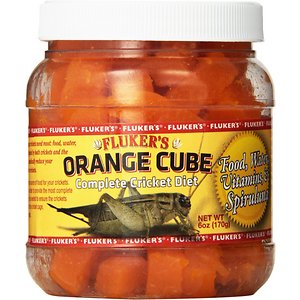
Fluker’s Orange Cube Complete Cricket Diet Reptile Supplement is the single solution to provide the three things crickets need most: food, water and vitamins. This supplement is specially formulated to be easily digested by both crickets and the animals that consume them. Orange Cube Complete Cricket Diet also drastically reduces the number of drowned, dehydrated and nutrient-deficient crickets, so there are plenty for your reptile to consume.
Price Score: 0 out of 100 Points
Variety Score: 78 out of 100 Points
Brand Score: 79 out of 100 Points
Ingredients Score: 65 out of 100 Points
Total Score: 60.4 out of 100 Points
Key Benefits
- Scientifically formulated gel cubes contain nutritious kelp, spirulina, brewer's yeast, and more to gutload crickets for a nutrition-packed meal
- Packed with essential vitamins, including Vitamins A, B12, E, and D3, as well as calcium
- Specially formulated to be a complete diet for a one step feeding solution
- Highly digestible by both crickets and your reptile or amphibian
- Gel cubes drastically reduce the number of drowned, dehydrated and nutrient-deficient crickets
Ingredients
Water, Carrageenan, Soya Protein, Dried Brewer's Yeast, Dried Kelp, Calcium Carbonate, Potassium, Sorbate, Ascorbic Acid, Citric Acid, Yellow #6 Food Color.See products with the same ingredients:
-
Ascorbic Acid - Harmless ingredient
(50)
Vitamin C, also known as ascorbic acid and ascorbate, is a vitamin found in various foods and sold as a dietary supplement. It is used to prevent and treat scurvy. Vitamin C is an essential nutrient involved in the repair of tissue and the enzymatic production of certain neurotransmitters.
-
Calcium Carbonate - Harmless ingredient
(155)
Calcium carbonate is a chemical compound with the formula CaCO3. It is a common substance found in rocks as the minerals calcite and aragonite and is the main component of pearls and the shells of marine organisms, snails, and eggs.
-
Carrageenan - Low-quality ingredient
(36)
Carrageenans or carrageenins are a family of linear sulfated polysaccharides that are extracted from red edible seaweeds. They are widely used in the food industry, for their gelling, thickening, and stabilizing properties. Their main application is in dairy and meat products, due to their strong binding to food proteins.
-
Citric Acid - Controversial ingredient
(61)
Citric acid is a weak organic acid that has the chemical formula C 6H 8O 7. It occurs naturally in citrus fruits. In biochemistry, it is an intermediate in the citric acid cycle, which occurs in the metabolism of all aerobic organisms.
-
Dried Brewer's Yeast (1)
-
Dried Kelp - Healthy ingredient
(43)
-
Potassium (3)
Potassium is a chemical element with the symbol K and atomic number 19. Potassium is a silvery-white metal that is soft enough to be cut with a knife with little force. Potassium metal reacts rapidly with atmospheric oxygen to form flaky white potassium peroxide in only seconds of exposure.
-
Sorbate (1)
Sorbic acid, or 2,4-hexadienoic acid, is a natural organic compound used as a food preservative. It has the chemical formula CH34CO2H. It is a colourless solid that is slightly soluble in water and sublimes readily. It was first isolated from the unripe berries of the Sorbus aucuparia, hence its name..
-
Soya Protein (1)
-
Water (68)
Water is an inorganic, transparent, tasteless, odorless, and nearly colorless chemical substance, which is the main constituent of Earth's hydrosphere and the fluids of most living organisms. It is vital for all known forms of life, even though it provides no calories or organic nutrients.
-
Yellow #6 Food Color (1)
Yellow is the color between orange and green on the spectrum of visible light. It is evoked by light with a dominant wavelength of roughly 570–590 nm. It is a primary color in subtractive color systems, used in painting or color printing.
Guaranteed Analysis
| Crude Protein | 3.5% min |
|---|---|
| Crude Fat | 0.1% min |
| Crude Fiber | 0.5% max |
| Moisture | 92.0% max |
| Calcium | 560 ppm min |
Dry Matter Basis
| Crude Protein | 43.8% |
|---|---|
| Crude Fat | 1.3% |
| Crude Fiber | 6.3% |
| Moisture | 1,150.0% |