Compare Prices To Find The Lowest Price




Description
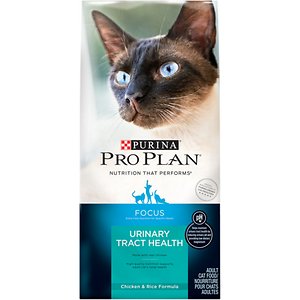
Purina Pro Plan Focus Adult Urinary Tract Health Formula is specially designed to help maintain your cat’s urinary tract health by reducing urinary pH and providing low dietary magnesium. Omega fatty acids and high-quality protein help support healthy skin and coat, and the formula is made with real chicken for a taste cats love. Every cat is special and you want the best for her. With over 50 formulas, Purina Pro Plan can help you find the best cat food to meet your cat’s unique needs. Give your cat exactly what she needs to excel. Purina Pro Plan Focus has specialized formulas to meet your cat’s unique nutritional needs. So whatever her size, age, or lifestyle, nurture the greatness in your cat. Complete and balanced nutrition for adult cats. Made with real chicken for a taste cats love. Helps maintain urinary health by reducing urinary pH and providing low dietary magnesium. Omega fatty acids and high-quality protein help support healthy skin and coat. Calcium, phosphorus and other nutrients help support bones and healthy joints. No added artificial color or flavor.
Price Score: 61 out of 100 Points
Variety Score: 100 out of 100 Points
Brand Score: 89 out of 100 Points
Ingredients Score: 65 out of 100 Points
Total Score: 78 out of 100 Points
Key Benefits
- Designed to help maintain your cat's urinary tract health by reducing urinary pH and providing low dietary magnesium.
- Omega fatty acids and high-quality protein help support healthy skin and coat.
- Made with real chicken for a taste cats love to devour!
- Calcium, phosphorus and other nutrients help support bones and healthy joints.
- 100% complete and balanced nutrition for adult cats with no added artificial colors or flavors.
Ingredients
Corn Gluten Meal, Chicken, Wheat Flour, Brewers Rice, Ground Yellow Corn, Animal Fat Preserved with Mixed-Tocopherols, Egg Product, Sodium Caseinate, Phosphoric Acid, Calcium Carbonate, Potassium Chloride, Animal Digest, Salt, L-Lysine Monohydrochloride, Dried Whey, Choline Chloride, Dicalcium Phosphate, Taurine, Zinc Sulfate, Ferrous Sulfate, Manganese Sulfate, Vitamin E Supplement, Niacin, Citric Acid, Vitamin A Supplement, Calcium Pantothenate, Thiamine Mononitrate, Copper Sulfate, Riboflavin Supplement, Vitamin B-12 Supplement, Pyridoxine Hydrochloride, Folic Acid, Vitamin D-3 Supplement, Calcium Iodate, Biotin, Menadione Sodium Bisulfite Complex (Source of Vitamin K Activity), Sodium Selenite. U-4625. Caloric Content 4,365 kcal/kg, 487 kcal/cupSee products with the same ingredients:
-
Animal Digest (21)
Animal digest is a common ingredient used in pet foods. As defined by the Association of American Feed Control Officials, digest is produced by the chemical or enzymatic hydrolysis of clean animal tissue that has not undergone decomposition. These animal tissues may not include hair, horns, teeth, hooves, or feathers, with the exclusion of trace amounts that are unavoidable even after acceptable processing methods.
-
Biotin - Harmless ingredient
(242)
Biotin also called vitamin H, vitamin B7 or vitamin B8 is a water-soluble B vitamin. It is involved in a wide range of metabolic processes, both in humans and in other organisms, primarily related to the utilization of fats, carbohydrates, and amino acids.
-
Brewers Rice (36)
-
Calcium Carbonate - Harmless ingredient
(155)
Calcium carbonate is a chemical compound with the formula CaCO3. It is a common substance found in rocks as the minerals calcite and aragonite and is the main component of pearls and the shells of marine organisms, snails, and eggs.
-
Calcium Iodate - Controversial ingredient
(126)
-
Calcium Pantothenate - Controversial ingredient
(135)
-
Chicken - Healthy ingredient
(141)
The chicken is a type of domesticated fowl, a subspecies of the red junglefowl. They are one of the most common and widespread domestic animals, with a total population of 23.7 billion as of 2018, up from more than 19 billion in 2011.
-
Choline Chloride - Harmless ingredient
(236)
Choline chloride is an organic compound with the formula 3NCH2CH2OH]Cl. It is bifunctional, containing both quaternary ammonium salt and an alcohol. The cation is choline, which occurs naturally. It is a white, water-soluble salt used mainly in animal feed..
-
Citric Acid - Controversial ingredient
(61)
Citric acid is a weak organic acid that has the chemical formula C 6H 8O 7. It occurs naturally in citrus fruits. In biochemistry, it is an intermediate in the citric acid cycle, which occurs in the metabolism of all aerobic organisms.
-
Copper Sulfate - Harmless ingredient
(159)
Copper sulfate, also known as copper sulphate, are the inorganic compounds with the chemical formula CuSO4x, where x can range from 0 to 5. The pentahydrate is the most common form. Older names for this compound include blue vitriol, bluestone, vitriol of copper, and Roman vitriol.
-
Corn Gluten Meal - Controversial ingredient
(49)
-
Dicalcium Phosphate - Harmful ingredient
(68)
-
Dried Whey (12)
-
Egg Product (10)
-
Ferrous Sulfate - Harmless ingredient
(166)
Iron sulfate sulphate) or ferrous sulfate denotes a range of salts with the formula FeSO4·xH2O. These compounds exist most commonly as the heptahydrate but are known for several values of x. The hydrated form is used medically to treat iron deficiency, and also for industrial applications.
-
Folic Acid - Harmless ingredient
(235)
Folate, also known as vitamin B9 and folacin, is one of the B vitamins. Manufactured folic acid, which is converted into folate by the body, is used as a dietary supplement and in food fortification as it is more stable during processing and storage.
-
Ground Yellow Corn (10)
-
L-Lysine Monohydrochloride (19)
-
Manganese Sulfate - Controversial ingredient
(138)
-
Niacin - Harmless ingredient
(238)
Niacin, also known as nicotinic acid, is an organic compound and a form of vitamin B3, an essential human nutrient. It has the formula C 6H 5NO 2 and belongs to the group of the pyridinecarboxylic acid. Niacin is obtained in the diet from a variety of whole and processed foods, with highest contents in fortified packaged foods, tuna, salmon, some vegetable and other animal sources.
-
Phosphoric Acid (29)
Phosphoric acid, also known as orthophosphoric acid or phosphoric acid, is a weak acid with the chemical formula H 3PO 4. It is a non-toxic compound which, when pure, is a solid at room temperature and pressure. All three hydrogens are acidic to varying degrees and can be lost from the molecule as H+ ions.
-
Potassium Chloride - Low-quality ingredient
(208)
Potassium chloride is a metal halide salt composed of potassium and chlorine. It is odorless and has a white or colorless vitreous crystal appearance. The solid dissolves readily in water, and its solutions have a salt-like taste. KCl is used as a fertilizer, in medicine, in scientific applications, and in food processing, where it may be known as E number additive E508.
-
Pyridoxine Hydrochloride - Harmless ingredient
(238)
-
Riboflavin - Harmless ingredient
(244)
Riboflavin, also known as vitamin B2, is a vitamin found in food and used as a dietary supplement. Food sources include eggs, green vegetables, milk and other dairy product, meat, mushrooms, and almonds. Some countries require its addition to grains. As a supplement it is used to prevent and treat riboflavin deficiency and prevent migraines.
-
Salt - Harmless ingredient
(231)
Salt is a mineral consisting primarily of sodium chloride, a chemical compound belonging to the larger class of salts; salt in its natural form as a crystalline mineral is known as rock salt or halite. Salt is present in vast quantities in seawater, where it is the main mineral constituent.
-
Sodium Caseinate (3)
Casein is a family of related phosphoproteins. These proteins are commonly found in mammalian milk, comprising c. 80% of the proteins in cow's milk and between 20% and 45% of the proteins in human milk. Sheep and buffalo milk have a higher casein content than other types of milk with human milk having a particularly low casein content.
-
Taurine - Healthy ingredient
(151)
Taurine, or 2-aminoethanesulfonic acid, is an organic compound that is widely distributed in animal tissues. It is a major constituent of bile and can be found in the large intestine, and accounts for up to 0.1% of total human body weight.
-
Thiamine Mononitrate - Harmless ingredient
(256)
-
Vitamin A - Harmless ingredient
(215)
Vitamin A is a group of unsaturated nutritional organic compounds that includes retinol, retinal, retinoic acid, and several provitamin A carotenoids. Vitamin A has multiple functions: it is important for growth and development, for the maintenance of the immune system, and for good vision.
-
Vitamin B12 - Harmless ingredient
(257)
Vitamin B12, also known as cobalamin, is a water-soluble vitamin involved in the metabolism of every cell of the human body: it is a cofactor in DNA synthesis, and in both fatty acid and amino acid metabolism. It is particularly important in the normal functioning of the nervous system via its role in the synthesis of myelin, and in the maturation of developing red blood cells in the bone marrow.
-
Vitamin D3 - Harmless ingredient
(244)
Cholecalciferol, also known as vitamin D3 and colecalciferol, is a type of vitamin D which is made by the skin when exposed to sunlight; it is also found in some foods and can be taken as a dietary supplement. It is used to treat and prevent vitamin D deficiency and associated diseases, including rickets.
-
Vitamin E - Harmless ingredient
(283)
Vitamin E is a group of eight fat soluble compounds that include four tocopherols and four tocotrienols. Vitamin E deficiency, which is rare and usually due to an underlying problem with digesting dietary fat rather than from a diet low in vitamin E, can cause nerve problems.
-
Vitamin K Activity (35)
-
Wheat Flour (34)
Wheat flour is a powder made from the grinding of wheat used for human consumption. Wheat varieties are called "soft" or "weak" if gluten content is low, and are called "hard" or "strong" if they have high gluten content. Hard flour, or bread flour, is high in gluten, with 12% to 14% gluten content, and its dough has elastic toughness that holds its shape well once baked.
-
Zinc Sulfate - Low-quality ingredient
(132)
Zinc sulfate is an inorganic compound and dietary supplement. As a supplement it is used to treat zinc deficiency and to prevent the condition in those at high risk. Side effects of excess supplementation may include abdominal pain, vomiting, headache, and tiredness.
Guaranteed Analysis
| Crude Protein | 31.0% min |
|---|---|
| Crude Fat | 14.0% min |
| Crude Fiber | 2.0% max |
| Moisture | 10.0% max |
| Ash | 6.2% max |
| Linoleic Acid | 1.6% min |
| Calcium | 0.7% min |
| Phosphorus | 0.6% min |
| Magnesium | 0.075% max |
Dry Matter Basis
| Crude Protein | 34.4% |
|---|---|
| Crude Fat | 15.6% |
| Crude Fiber | 2.2% |
| Moisture | 11.1% |