Compare Prices To Find The Lowest Price



Description
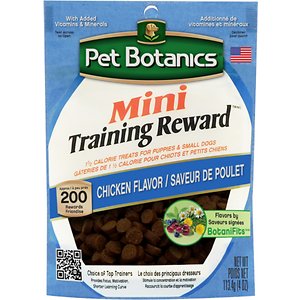
Treat your dog to layer after layer of goodness with the Pet Botanics Mini Training Rewards. Made with real pork liver and enhanced with Pet Botanics’s own natural nutrient blend, BotaniFits, these treats are a healthy and nutritious way to train. They’re perfectly sized for repetitive reward training at just 1/2 calories per treat and over 500 treats per bag—which means they’re a healthy, guilt-free bang for your buck! They’re easy to carry in your pocket for easy training on the go, especially because their moist texture won’t crumble and break, leaving you with a pocket full of crumbs. The perfect training treat provides focus, motivation, and a shorter learning curve, so Pet Botanics brings you that and more with their training rewards line.
Price Score: 49 out of 100 Points
Variety Score: 49 out of 100 Points
Brand Score: 94 out of 100 Points
Ingredients Score: 78 out of 100 Points
Total Score: 73 out of 100 Points
Key Benefits
- Training treats made with real pork liver and enhanced with BotaniFits—a natural nutrient blend created by Pet Botanics—for a healthy, nutritious motivation boost.
- Perfectly-sized and packaged for repetitive reward training, with only 1/2 calories per treat and over 500 treats per bag.
- Easy to carry in your pocket for rewarding on the go—take a training field trip to the park, or just bring your routine out to the backyard.
- The moist texture won’t crumble or break, and the bite-sized chews great for dogs of all sizes.
- This choice of top trainers provides focus, motivation, and a shorter learning curve for dogs of all ages—even old dogs learning new tricks!
Ingredients
Pork Liver, Pea Flour, Potatoes, Dried Whole Eggs, Glycerin, Sugar, Brown Rice, Chicken Fat (Preserved with Mixed Tocopherols), Barley Flour, Tapioca Flour, Chicken, Sweet Potatoes, Natural Smoke Flavor, Sodium Lactate, Lecithin, Salt, Flaxseed, Lactic Acid, Carrageenan, Palm Oil, Phosphoric Acid, Salmon Oil, Molasses, Calcium and Zinc Proprionates, Caramel Color, Garlic, Mustard, Added Color (Iron Oxide), Carrots, Natural Bacon Flavor (Green Tea, Cranberries, Peppermint, Chamomile, Rosemary, Dandelion, Tomato, Blueberry). Caloric Content 3,120 kcal/kg, 1.2 kcal/treatSee products with the same ingredients:
-
Added Color (27)
-
Barley Flour (4)
-
Brown Rice (22)
Brown rice is a whole-grain rice with the inedible outer hull removed. This is as compared with white rice, which is the same grain, also with hull removed, but also with the bran layer and cereal germ removed. Red rice, gold rice, and black rice are all whole rices, but with differently pigmented outer layers.
-
Calcium (4)
Calcium is a chemical element with the symbol Ca and atomic number 20. As an alkaline earth metal, calcium is a reactive metal that forms a dark oxide-nitride layer when exposed to air. Its physical and chemical properties are most similar to its heavier homologues strontium and barium.
-
Caramel Color (11)
Caramel color or caramel coloring is a water-soluble food coloring. It is made by heat treatment of carbohydrates, in general in the presence of acids, alkalis, or salts, in a process called caramelization. It is more fully oxidized than caramel candy, and has an odor of burnt sugar and a somewhat bitter taste.
-
Carrageenan - Low-quality ingredient
(36)
Carrageenans or carrageenins are a family of linear sulfated polysaccharides that are extracted from red edible seaweeds. They are widely used in the food industry, for their gelling, thickening, and stabilizing properties. Their main application is in dairy and meat products, due to their strong binding to food proteins.
-
Carrots - Healthy ingredient
(70)
The carrot (Daucus carota subsp. sativus) is a root vegetable, usually orange in colour, though purple, black, red, white, and yellow cultivars exist. They are a domesticated form of the wild carrot, Daucus carota, native to Europe and Southwestern Asia. The plant probably originated in Persia and was originally cultivated for its leaves and seeds.
-
Chamomile (4)
Chamomile or camomile is the common name for several daisy-like plants of the family Asteraceae. Two of the species are commonly used to make herbal infusions for traditional medicine, although there is no evidence that chamomile has any effect on health or diseases..
-
Chicken - Healthy ingredient
(141)
The chicken is a type of domesticated fowl, a subspecies of the red junglefowl. They are one of the most common and widespread domestic animals, with a total population of 23.7 billion as of 2018, up from more than 19 billion in 2011.
-
Chicken Fat - Healthy ingredient
(71)
Chicken fat is fat obtained from chicken rendering and processing. Of the many animal-sourced substances, chicken fat is noted for being high in linoleic acid, an omega-6 fatty acid. Linoleic acid levels are between 17.9% and 22.8%. It is a common flavoring, additive or main component of chicken soup.
-
Cranberries (34)
The cranberry is a group of evergreen dwarf shrubs, bearing the fruit named after such. Cranberry may also refer to:.
-
Dandelion (5)
Taraxacum is a large genus of flowering plants in the family Asteraceae, which consists of species commonly known as dandelions. The genus is native to Eurasia and North America, but the two commonplace species worldwide, T. officinale and T. erythrospermum, were introduced from Europe and now propagate as wildflowers.
-
Dried Whole Eggs (3)
-
Flaxseed - Healthy ingredient
(47)
Flax, also known as common flax or linseed, is a member of the genus Linum in the family Linaceae. It is a food and fiber crop cultivated in cooler regions of the world. Textiles made from flax are known in the Western countries as linen, and traditionally used for bed sheets, underclothes, and table linen.
-
Garlic (7)
Garlic is a species in the onion genus, Allium. Its close relatives include the onion, shallot, leek, chive, and Chinese onion. Garlic is native to Central Asia and northeastern Iran, and has long been a common seasoning worldwide, with a history of several thousand years of human consumption and use.
-
Glycerin - Controversial ingredient
(40)
Glycerol is a simple polyol compound. It is a colorless, odorless, viscous liquid that is sweet-tasting and non-toxic. The glycerol backbone is found in those lipids known as glycerides. Due to having antimicrobial and antiviral properties it is widely used in FDA approved wound and burn treatments.
-
Lactic Acid (12)
Lactic acid is an organic acid. It has a molecular formula CH3CHCOOH. It is white in solid state and it is miscible with water. While in liquid state it is a colorless solution. Production includes both artificial synthesis as well as natural sources.
-
Lecithin - Harmless ingredient
(41)
Lecithin is a generic term to designate any group of yellow-brownish fatty substances occurring in animal and plant tissues which are amphiphilic – they attract both water and fatty substances, and are used for smoothing food textures, emulsifying, homogenizing liquid mixtures, and repelling sticking materials.
-
Molasses (7)
Molasses or black treacle is a viscous product resulting from refining sugarcane or sugar beets into sugar. Molasses varies by amount of sugar, method of extraction, and age of plant. Sugarcane molasses is primarily used for sweetening and flavoring foods in the United States, Canada, and elsewhere.
-
Mustard (4)
Mustard may refer to:.
-
Natural Bacon Flavor Green Tea (1)
-
Natural Smoke Flavor (19)
-
Palm Oil (6)
Palm oil is an edible vegetable oil derived from the mesocarp of the fruit of the oil palms, primarily the African oil palm Elaeis guineensis, and to a lesser extent from the American oil palm Elaeis oleifera and the maripa palm Attalea maripa.
-
Pea Flour (12)
-
Peppermint (6)
Peppermint is a hybrid mint, a cross between watermint and spearmint. Indigenous to Europe and the Middle East, the plant is now widely spread and cultivated in many regions of the world. It is occasionally found in the wild with its parent species.
-
Phosphoric Acid (29)
Phosphoric acid, also known as orthophosphoric acid or phosphoric acid, is a weak acid with the chemical formula H 3PO 4. It is a non-toxic compound which, when pure, is a solid at room temperature and pressure. All three hydrogens are acidic to varying degrees and can be lost from the molecule as H+ ions.
-
Pork Liver (16)
-
Potatoes (34)
The potato is a root vegetable native to the Americas, a starchy tuber of the plant Solanum tuberosum, and the plant itself, a perennial in the family Solanaceae. Wild potato species can be found throughout the Americas, from the United States to southern Chile.
-
Rosemary (10)
Salvia rosmarinus, commonly known as rosemary, is a woody, perennial herb with fragrant, evergreen, needle-like leaves and white, pink, purple, or blue flowers, native to the Mediterranean region. Until 2017, it was known by the scientific name Rosmarinus officinalis, now a synonym.
-
Salmon Oil - Healthy ingredient
(44)
-
Salt - Harmless ingredient
(231)
Salt is a mineral consisting primarily of sodium chloride, a chemical compound belonging to the larger class of salts; salt in its natural form as a crystalline mineral is known as rock salt or halite. Salt is present in vast quantities in seawater, where it is the main mineral constituent.
-
Sodium Lactate (3)
-
Sugar (27)
Sugar is the generic name for sweet-tasting, soluble carbohydrates, many of which are used in food. Simple sugars, also called monosaccharides, include glucose, fructose, and galactose. Compound sugars, also called disaccharides or double sugars, are molecules composed of two monosaccharides joined by a glycosidic bond.
-
Sweet Potatoes - Controversial ingredient
(38)
-
Tapioca Flour (4)
-
Tomato (7)
The tomato is the edible, often red, berry of the plant Solanum lycopersicum, commonly known as a tomato plant. The species originated in western South America and Central America. The Nahuatl word tomatl gave rise to the Spanish word tomate, from which the English word tomato derived.
-
Zinc Proprionates (2)
Guaranteed Analysis
| Crude Protein | 12.0% min |
|---|---|
| Crude Fat | 7.0% min |
| Crude Fiber | 4.0% max |
| Moisture | 30.0% max |
Dry Matter Basis
| Crude Protein | 17.1% |
|---|---|
| Crude Fat | 10.0% |
| Crude Fiber | 5.7% |
| Moisture | 42.9% |