Compare Prices To Find The Lowest Price



Description
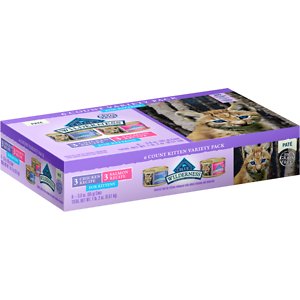
Take a walk on the deliciously wild side with the Blue Buffalo Wilderness Pate Kitten Variety Pack with Chicken & Salmon Grain-Free Cat Food Trays. Inspired by the lynx, a carnivore who thrives on meat, this variety pack is crafted especially for the nutritional needs of kittens. Each recipe is made with only the finest, natural ingredients like real, protein-rich fish and meat—and equally important is what’s not in them. This food leaves out all the stuff that isn’t good or nutritious for your cat, because that’s just how nature intended it. With delectable flavors in a pate form, his bowl won’t stay full for long.
Price Score: 51 out of 100 Points
Variety Score: 49 out of 100 Points
Brand Score: 21.25 out of 100 Points
Ingredients Score: 70 out of 100 Points
Total Score: 54.25 out of 100 Points
Key Benefits
- Holistic and natural protein-rich nutrition with delectable flavors crafted just for the needs of kittens.
- Made with real meat or fish, plus added vitamins and minerals for a complete and balanced diet.
- Inspired by a naturally wild diet, these protein-rich recipes cater to your kitten’s inner carnivore.
- Made in the USA with only real ingredients and never any chicken or poultry by-product meals.
- Great for allergies with no grains, corn, wheat or soy or artificial preservatives, colors or flavors.
Ingredients
Chicken: Chicken, Chicken Broth, Salmon Oil (Source Of Dha-Docosahexaenoic Acid), Potatoes, Guar Gum, Natural Flavor, Flaxseed (Source Of Omega 3 And 6 Fatty Acids), Potassium Chloride, Taurine, Choline Chloride, Carrageenan, Cassia Gum, Iron Amino Acid Chelate, Zinc Amino Acid Chelate, Vitamin E Supplement, Thiamine Mononitrate (Vitamin B1), Mixed Tocopherols, Copper Amino Acid Chelate, Manganese Amino Acid Chelate, Sodium Selenite, Niacin Supplement (Vitamin B3), Calcium Pantothenate (Vitamin B5), Pyridoxine Hydrochloride (Vitamin B6), Riboflavin Supplement (Vitamin B2), Vitamin A Supplement, Biotin (Vitamin B7), Potassium Iodide, Vitamin D3 Supplement, Vitamin B12 Supplement, Folic Acid (Vitamin B9). Salmon: Salmon, Chicken, Fish Broth, Chicken Liver, Peas, Natural Flavor, Guar Gum, Flaxseed (Source Of Omega 3 And 6 Fatty Acids), Fish Oil (Source Of Dha- Docosahexaenoic Acid), Potassium Chloride, Taurine, Salt, Dried Potato, Carrageenan, Cassia Gum, Choline Chloride, Iron Amino Acid Chelate, Zinc Amino Acid Chelate, Vitamin E Supplement, Thiamine Mononitrate (Vitamin B1), Copper Amino Acid Chelate, Manganese Amino Acid Chelate, Sodium Selenite, Niacin Supplement (Vitamin B3), Calcium Pantothenate (Vitamin B5), Pyridoxine Hydrochloride (Vitamin B6), Riboflavin Supplement (Vitamin B2), Vitamin A Supplement, Biotin (Vitamin B7), Potassium Iodide, Vitamin D3 Supplement, Vitamin B12 Supplement, Folic Acid (Vitamin B9). Caloric Content Chicken: 1,483 kcal/kg, 126 kcal/can; Salmon: 1,340 kcal/kg, 113 kcal/canSee products with the same ingredients:
-
Biotin - Harmless ingredient
(242)
Biotin also called vitamin H, vitamin B7 or vitamin B8 is a water-soluble B vitamin. It is involved in a wide range of metabolic processes, both in humans and in other organisms, primarily related to the utilization of fats, carbohydrates, and amino acids.
-
Calcium Pantothenate - Controversial ingredient
(135)
-
Carrageenan - Low-quality ingredient
(36)
Carrageenans or carrageenins are a family of linear sulfated polysaccharides that are extracted from red edible seaweeds. They are widely used in the food industry, for their gelling, thickening, and stabilizing properties. Their main application is in dairy and meat products, due to their strong binding to food proteins.
-
Cassia Gum (8)
-
Chicken - Healthy ingredient
(141)
The chicken is a type of domesticated fowl, a subspecies of the red junglefowl. They are one of the most common and widespread domestic animals, with a total population of 23.7 billion as of 2018, up from more than 19 billion in 2011.
-
Chicken broth (24)
Broth, also known as bouillon, is a savory liquid made of water in which bones, meat, or vegetables have been simmered. It can be eaten alone, but it is most commonly used to prepare other dishes, such as soups, gravies, and sauces.
-
Chicken Liver - Healthy ingredient
(38)
-
Choline Chloride - Harmless ingredient
(236)
Choline chloride is an organic compound with the formula 3NCH2CH2OH]Cl. It is bifunctional, containing both quaternary ammonium salt and an alcohol. The cation is choline, which occurs naturally. It is a white, water-soluble salt used mainly in animal feed..
-
Copper Amino Acid Chelate (34)
-
Dried Potato (3)
-
Fish Broth (8)
-
Fish Oil - Healthy ingredient
(59)
-
Flaxseed - Healthy ingredient
(47)
Flax, also known as common flax or linseed, is a member of the genus Linum in the family Linaceae. It is a food and fiber crop cultivated in cooler regions of the world. Textiles made from flax are known in the Western countries as linen, and traditionally used for bed sheets, underclothes, and table linen.
-
Folic Acid - Harmless ingredient
(235)
Folate, also known as vitamin B9 and folacin, is one of the B vitamins. Manufactured folic acid, which is converted into folate by the body, is used as a dietary supplement and in food fortification as it is more stable during processing and storage.
-
Guar Gum - Controversial ingredient
(69)
Guar gum, also called guaran, is a galactomannan polysaccharide extracted from guar beans that has thickening and stabilizing properties useful in food, feed, and industrial applications. The guar seeds are mechanically dehusked, hydrated, milled and screened according to application. It is typically produced as a free-flowing, off-white powder..
-
Iron Amino Acid Chelate (35)
-
Manganese Amino Acid Chelate (31)
-
Mixed Tocopherols - Low-quality ingredient
(83)
-
Natural Flavor - Controversial ingredient
(106)
-
Niacin - Harmless ingredient
(238)
Niacin, also known as nicotinic acid, is an organic compound and a form of vitamin B3, an essential human nutrient. It has the formula C 6H 5NO 2 and belongs to the group of the pyridinecarboxylic acid. Niacin is obtained in the diet from a variety of whole and processed foods, with highest contents in fortified packaged foods, tuna, salmon, some vegetable and other animal sources.
-
Peas - Healthy ingredient
(68)
The pea is most commonly the small spherical seed or the seed-pod of the pod fruit Pisum sativum. Each pod contains several peas, which can be green or yellow. Botanically, pea pods are fruit, since they contain seeds and develop from the ovary of a flower.
-
Potassium Chloride - Low-quality ingredient
(208)
Potassium chloride is a metal halide salt composed of potassium and chlorine. It is odorless and has a white or colorless vitreous crystal appearance. The solid dissolves readily in water, and its solutions have a salt-like taste. KCl is used as a fertilizer, in medicine, in scientific applications, and in food processing, where it may be known as E number additive E508.
-
Potassium Iodide - Harmless ingredient
(85)
Potassium iodide is a chemical compound, medication, and dietary supplement. As a medication it is used to treat hyperthyroidism, in radiation emergencies, and to protect the thyroid gland when certain types of radiopharmaceuticals are used. In the developing world it is also used to treat skin sporotrichosis and phycomycosis.
-
Potatoes (34)
The potato is a root vegetable native to the Americas, a starchy tuber of the plant Solanum tuberosum, and the plant itself, a perennial in the family Solanaceae. Wild potato species can be found throughout the Americas, from the United States to southern Chile.
-
Pyridoxine Hydrochloride - Harmless ingredient
(238)
-
Riboflavin - Harmless ingredient
(244)
Riboflavin, also known as vitamin B2, is a vitamin found in food and used as a dietary supplement. Food sources include eggs, green vegetables, milk and other dairy product, meat, mushrooms, and almonds. Some countries require its addition to grains. As a supplement it is used to prevent and treat riboflavin deficiency and prevent migraines.
-
Salmon Oil - Healthy ingredient
(44)
-
Salt - Harmless ingredient
(231)
Salt is a mineral consisting primarily of sodium chloride, a chemical compound belonging to the larger class of salts; salt in its natural form as a crystalline mineral is known as rock salt or halite. Salt is present in vast quantities in seawater, where it is the main mineral constituent.
-
Sodium Selenite - Harmful ingredient
(166)
-
Taurine - Healthy ingredient
(151)
Taurine, or 2-aminoethanesulfonic acid, is an organic compound that is widely distributed in animal tissues. It is a major constituent of bile and can be found in the large intestine, and accounts for up to 0.1% of total human body weight.
-
Thiamine Mononitrate - Harmless ingredient
(256)
-
Vitamin A - Harmless ingredient
(215)
Vitamin A is a group of unsaturated nutritional organic compounds that includes retinol, retinal, retinoic acid, and several provitamin A carotenoids. Vitamin A has multiple functions: it is important for growth and development, for the maintenance of the immune system, and for good vision.
-
Vitamin B12 - Harmless ingredient
(257)
Vitamin B12, also known as cobalamin, is a water-soluble vitamin involved in the metabolism of every cell of the human body: it is a cofactor in DNA synthesis, and in both fatty acid and amino acid metabolism. It is particularly important in the normal functioning of the nervous system via its role in the synthesis of myelin, and in the maturation of developing red blood cells in the bone marrow.
-
Vitamin D3 - Harmless ingredient
(244)
Cholecalciferol, also known as vitamin D3 and colecalciferol, is a type of vitamin D which is made by the skin when exposed to sunlight; it is also found in some foods and can be taken as a dietary supplement. It is used to treat and prevent vitamin D deficiency and associated diseases, including rickets.
-
Vitamin E - Harmless ingredient
(283)
Vitamin E is a group of eight fat soluble compounds that include four tocopherols and four tocotrienols. Vitamin E deficiency, which is rare and usually due to an underlying problem with digesting dietary fat rather than from a diet low in vitamin E, can cause nerve problems.
-
Zinc Amino Acid Chelate (33)
Guaranteed Analysis
| Crude Protein | 10.5% min |
|---|---|
| Crude Fat | 9.0% min |
| Crude Fiber | 1.5% max |
| Moisture | 78.0% max |
| Taurine | 0.10% min |
| DHA | 0.10% min |
Dry Matter Basis
| Crude Protein | 47.7% |
|---|---|
| Crude Fat | 40.9% |
| Crude Fiber | 6.8% |
| Moisture | 354.5% |