Compare Prices To Find The Lowest Price




Description
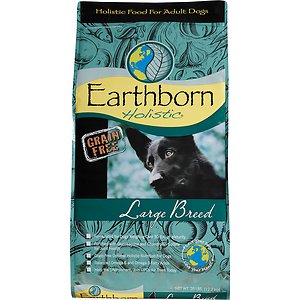
Earthborn Holistic Large Breed Grain-Free Dry Dog Food is a special blend scientifically formulated to meet the special needs of dogs that will weigh over 50 pounds at maturity. Made with a precise balance of protein, fat and carbohydrates, Large Breed formula provides the special diet large and giant breed dogs need for bones, joints and overall good health. Chicken meal as a high-quality protein source combined with wholesome vegetables and fruits such as peas, apples, blueberries, carrots, spinach and cranberries provides a grain-free meal that helps meet your dog’s nutritional needs. Chelated minerals are easily absorbed into the tissues of your dog’s body for optimum nutrition.
Price Score: 65 out of 100 Points
Variety Score: 71 out of 100 Points
Brand Score: 90 out of 100 Points
Ingredients Score: 65 out of 100 Points
Total Score: 76.2 out of 100 Points
Key Benefits
- This special blend is scientifically formulated to meet the special needs of dogs that will weight over 50 lbs at maturity. Made with a precise balance of protein, fat and carbohydrates, this formula provides the special diet large and giant breed dogs need for bones, joints and overall good health
- Fortified with glucosamine and chondroitin sulfate, this formula helps maintain healthy joint cartilage. L-carnitine helps burn fat and maintain lean muscle mass to support a healthy, active lifestyle. A proper ratio of omega 6 and omega 3 fatty acids helps support a lipid balance for healthy skin and coat
- Chicken meal provides a high quality protein source. The grain-free formula combined with high quality, wholesome vegetables and fruits such as peas, apples, blueberries, carrots and spinach help meet your dog’s daily nutritional needs. Chelated minerals are easily absorbed into the tissues of your dog’s body for optimum nutrition
- Made free of grain and gluten, this special formula is perfect as an alternative to grain-based foods.
- Fibers from vegetables and fruits help support excellent digestibility and nutrient absorption
Ingredients
Chicken Meal, Peas, Tapioca, Chicken Fat (Preserved with Mixed Tocopherols), Ground Flaxseed, Pea Fiber, Dried Egg Product, Whitefish Meal, Natural Flavors, Dicalcium Phosphate, Apples, Blueberries, Carrots, Spinach, Blueberry Fiber, Cranberry Fiber, Potassium Chloride, Salt, Choline Chloride, Dl-Methionine, L-Lysine, Taurine, Glucosamine Hydrochloride, Chondroitin Sulfate, Yucca Schidigera Extract, L-Carnitine, Beta-Carotene, Vitamin A Supplement, Vitamin D3 Supplement, Vitamin E Supplement, Zinc Sulfate, L-Ascorbyl-2-Polyphosphate (Source of Vitamin C), Ferrous Sulfate, Niacin, Calcium Pantothenate, Riboflavin Supplement, Copper Sulfate, Pyridoxine Hydrochloride, Thiamine Mononitrate, Manganese Sulfate, Zinc Proteinate, Manganese Proteinate, Copper Proteinate, Calcium Iodate, Cobalt Carbonate, Folic Acid, Sodium Selenite, Biotin, Vitamin B12 Supplement, Dried Lactobacillus Plantarum Fermentation Product, Dried Enterococcus Faecium Fermentation Product, Dried Lactobacillus Casei Fermentation Product, Dried Lactobacillus Acidophilus Fermentation Product. Caloric Content 3,500 kcal/kg, 370 kcal/cupSee products with the same ingredients:
-
Apples (23)
An apple is a sweet, edible fruit produced by an apple tree. Apple trees are cultivated worldwide and are the most widely grown species in the genus Malus. The tree originated in Central Asia, where its wild ancestor, Malus sieversii, is still found today.
-
Beta carotene (16)
β-Carotene is an organic, strongly colored red-orange pigment abundant in plants and fruits. It is a member of the carotenes, which are terpenoids, synthesized biochemically from eight isoprene units and thus having 40 carbons. Among the carotenes, β-carotene is distinguished by having beta-rings at both ends of the molecule.
-
Biotin - Harmless ingredient
(242)
Biotin also called vitamin H, vitamin B7 or vitamin B8 is a water-soluble B vitamin. It is involved in a wide range of metabolic processes, both in humans and in other organisms, primarily related to the utilization of fats, carbohydrates, and amino acids.
-
Blueberries (34)
Blueberries are perennial flowering plants with blue or purple–colored berries. They are classified in the section Cyanococcus within the genus Vaccinium. Vaccinium also includes cranberries, bilberries, huckleberries and Madeira blueberries. Commercial "blueberries" – including both wild and cultivated blueberries – are all native to North America.
-
Blueberry Fiber (1)
-
Calcium Iodate - Controversial ingredient
(126)
-
Calcium Pantothenate - Controversial ingredient
(135)
-
Carrots - Healthy ingredient
(70)
The carrot (Daucus carota subsp. sativus) is a root vegetable, usually orange in colour, though purple, black, red, white, and yellow cultivars exist. They are a domesticated form of the wild carrot, Daucus carota, native to Europe and Southwestern Asia. The plant probably originated in Persia and was originally cultivated for its leaves and seeds.
-
Chicken Fat - Healthy ingredient
(71)
Chicken fat is fat obtained from chicken rendering and processing. Of the many animal-sourced substances, chicken fat is noted for being high in linoleic acid, an omega-6 fatty acid. Linoleic acid levels are between 17.9% and 22.8%. It is a common flavoring, additive or main component of chicken soup.
-
Chicken Meal - Healthy ingredient
(55)
-
Choline Chloride - Harmless ingredient
(236)
Choline chloride is an organic compound with the formula 3NCH2CH2OH]Cl. It is bifunctional, containing both quaternary ammonium salt and an alcohol. The cation is choline, which occurs naturally. It is a white, water-soluble salt used mainly in animal feed..
-
Chondroitin Sulfate (17)
-
Cobalt Carbonate (12)
Cobalt carbonate is the inorganic compound with the formula CoCO3. This reddish paramagnetic solid is an intermediate in the hydrometallurgical purification of cobalt from its ores. It is an inorganic pigment, and a precursor to catalysts. Cobalt carbonate also occurs as the rare red/pink mineral spherocobaltite..
-
Copper Proteinate - Controversial ingredient
(89)
-
Copper Sulfate - Harmless ingredient
(159)
Copper sulfate, also known as copper sulphate, are the inorganic compounds with the chemical formula CuSO4x, where x can range from 0 to 5. The pentahydrate is the most common form. Older names for this compound include blue vitriol, bluestone, vitriol of copper, and Roman vitriol.
-
Cranberry Fiber (1)
-
Dicalcium Phosphate - Harmful ingredient
(68)
-
Dl-Methionine - Healthy ingredient
(62)
Methionine is an essential amino acid in humans. As the substrate for other amino acids such as cysteine and taurine, versatile compounds such as SAM-e, and the important antioxidant glutathione, methionine plays a critical role in the metabolism and health of many species, including humans.
-
Dried Egg Product - Low-quality ingredient
(37)
-
Dried Enterococcus Faecium Fermentation Product (36)
-
Dried Lactobacillus Casei Fermentation Product (29)
-
Dried Lactobacillus Plantarum Fermentation Product (23)
-
Ferrous Sulfate - Harmless ingredient
(166)
Iron sulfate sulphate) or ferrous sulfate denotes a range of salts with the formula FeSO4·xH2O. These compounds exist most commonly as the heptahydrate but are known for several values of x. The hydrated form is used medically to treat iron deficiency, and also for industrial applications.
-
Folic Acid - Harmless ingredient
(235)
Folate, also known as vitamin B9 and folacin, is one of the B vitamins. Manufactured folic acid, which is converted into folate by the body, is used as a dietary supplement and in food fortification as it is more stable during processing and storage.
-
Glucosamine Hydrochloride (16)
-
Ground Flaxseed (23)
-
L-Carnitine (27)
Carnitine is a quaternary ammonium compound involved in metabolism in most mammals, plants, and some bacteria. Carnitine exists as one of two stereoisomers. Both are biologically active but only l-carnitine naturally occurs in animals and d-carnitine is toxic as it inhibits the activity of the l-form.
-
L-Lysine (23)
Lysine is an α-amino acid that is used in the biosynthesis of proteins. It contains an α-amino group, an α-carboxylic acid group, and a side chain lysyl 4NH2), classifying it as a basic, charged, aliphatic amino acid.
-
Manganese Proteinate - Controversial ingredient
(78)
-
Manganese Sulfate - Controversial ingredient
(138)
-
Natural Flavors - Controversial ingredient
(38)
Flavor, flavour, or taste is the perceptual impression of food or other substances, and is determined primarily by the chemical senses of the gustatory and olfactory system. The "trigeminal senses", which detect chemical irritants in the mouth and throat, as well as temperature and texture, are also important to the overall gestalt of flavor perception.
-
Niacin - Harmless ingredient
(238)
Niacin, also known as nicotinic acid, is an organic compound and a form of vitamin B3, an essential human nutrient. It has the formula C 6H 5NO 2 and belongs to the group of the pyridinecarboxylic acid. Niacin is obtained in the diet from a variety of whole and processed foods, with highest contents in fortified packaged foods, tuna, salmon, some vegetable and other animal sources.
-
Pea Fiber (17)
-
Peas - Healthy ingredient
(68)
The pea is most commonly the small spherical seed or the seed-pod of the pod fruit Pisum sativum. Each pod contains several peas, which can be green or yellow. Botanically, pea pods are fruit, since they contain seeds and develop from the ovary of a flower.
-
Potassium Chloride - Low-quality ingredient
(208)
Potassium chloride is a metal halide salt composed of potassium and chlorine. It is odorless and has a white or colorless vitreous crystal appearance. The solid dissolves readily in water, and its solutions have a salt-like taste. KCl is used as a fertilizer, in medicine, in scientific applications, and in food processing, where it may be known as E number additive E508.
-
Pyridoxine Hydrochloride - Harmless ingredient
(238)
-
Riboflavin - Harmless ingredient
(244)
Riboflavin, also known as vitamin B2, is a vitamin found in food and used as a dietary supplement. Food sources include eggs, green vegetables, milk and other dairy product, meat, mushrooms, and almonds. Some countries require its addition to grains. As a supplement it is used to prevent and treat riboflavin deficiency and prevent migraines.
-
Salt - Harmless ingredient
(231)
Salt is a mineral consisting primarily of sodium chloride, a chemical compound belonging to the larger class of salts; salt in its natural form as a crystalline mineral is known as rock salt or halite. Salt is present in vast quantities in seawater, where it is the main mineral constituent.
-
Sodium Selenite - Harmful ingredient
(166)
-
Spinach (22)
Spinach is a leafy green flowering plant native to central and western Asia. It is of the order Caryophyllales, family Amaranthaceae, subfamily Chenopodioideae. Its leaves are a common edible vegetable consumed either fresh, or after storage using preservation techniques by canning, freezing, or dehydration.
-
Tapioca (12)
Tapioca is a starch extracted from the storage roots of the cassava plant. This species is native to the north region and central-west region of Brazil, but its use spread throughout South America. The plant was carried by Portuguese and Spanish colonisers to most of the West Indies and Africa and Asia.
-
Taurine - Healthy ingredient
(151)
Taurine, or 2-aminoethanesulfonic acid, is an organic compound that is widely distributed in animal tissues. It is a major constituent of bile and can be found in the large intestine, and accounts for up to 0.1% of total human body weight.
-
Thiamine Mononitrate - Harmless ingredient
(256)
-
Vitamin A - Harmless ingredient
(215)
Vitamin A is a group of unsaturated nutritional organic compounds that includes retinol, retinal, retinoic acid, and several provitamin A carotenoids. Vitamin A has multiple functions: it is important for growth and development, for the maintenance of the immune system, and for good vision.
-
Vitamin B12 - Harmless ingredient
(257)
Vitamin B12, also known as cobalamin, is a water-soluble vitamin involved in the metabolism of every cell of the human body: it is a cofactor in DNA synthesis, and in both fatty acid and amino acid metabolism. It is particularly important in the normal functioning of the nervous system via its role in the synthesis of myelin, and in the maturation of developing red blood cells in the bone marrow.
-
Vitamin C - Harmless ingredient
(60)
Vitamin C, also known as ascorbic acid and ascorbate, is a vitamin found in various foods and sold as a dietary supplement. It is used to prevent and treat scurvy. Vitamin C is an essential nutrient involved in the repair of tissue and the enzymatic production of certain neurotransmitters.
-
Vitamin D3 - Harmless ingredient
(244)
Cholecalciferol, also known as vitamin D3 and colecalciferol, is a type of vitamin D which is made by the skin when exposed to sunlight; it is also found in some foods and can be taken as a dietary supplement. It is used to treat and prevent vitamin D deficiency and associated diseases, including rickets.
-
Vitamin E - Harmless ingredient
(283)
Vitamin E is a group of eight fat soluble compounds that include four tocopherols and four tocotrienols. Vitamin E deficiency, which is rare and usually due to an underlying problem with digesting dietary fat rather than from a diet low in vitamin E, can cause nerve problems.
-
Whitefish Meal (9)
-
Yucca Schidigera Extract - Harmless ingredient
(41)
-
Zinc Proteinate - Controversial ingredient
(79)
-
Zinc Sulfate - Low-quality ingredient
(132)
Zinc sulfate is an inorganic compound and dietary supplement. As a supplement it is used to treat zinc deficiency and to prevent the condition in those at high risk. Side effects of excess supplementation may include abdominal pain, vomiting, headache, and tiredness.
Guaranteed Analysis
| Crude Protein | 26.0% min |
|---|---|
| Crude Fat | 13.0% min |
| Crude Fiber | 5.0% max |
| Moisture | 10.0% max |
| Calcium | 1.1% min |
| Phosphorus | 0.8% min |
| Vitamin E | 250 IU/kg min |
| Ascorbic Acid | 100 mg/kg min |
| L-Carnitine | 50 mg/kg min |
| Beta-Carotene | 5 mg/kg min |
| Taurine | 0.05% min |
| Omega-6 Fatty Acids | 2.5% min |
| Omega-3 Fatty Acids | 0.9% min |
| Docosahexaenoic Acid (DHA) | 0.05% min |
| Glucosamine | 400 mg/kg min |
| Chondroitin SulFate | 250 mg/kg min |
Dry Matter Basis
| Crude Protein | 28.9% |
|---|---|
| Crude Fat | 14.4% |
| Crude Fiber | 5.6% |
| Moisture | 11.1% |