Compare Prices To Find The Lowest Price



Description
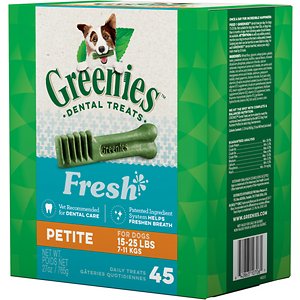
Give your pal the mouth-wowing treat that boosts dental health with Greenies Fresh Petite Dental Dog Treats! Made with all-natural ingredients, these uniquely-shaped snacks are designed to control and remove disease-causing plaque and tartar, while dried spearmint helps knock out dreaded doggie breath. Each tasty chew features added vitamins and minerals, and is formulated to provide complete and balanced nutrition for adult dogs. Keep the cuddles coming and give your best friend the dental health she deserves with these veterinarian-recommended dental treats.
Variety Score: 26 out of 100 Points
Brand Score: 89 out of 100 Points
Ingredients Score: 64 out of 100 Points
Total Score: 68.5 out of 100 Points
Key Benefits
- Recommended by veterinarians to help prevent gum disease, freshen breath and reduce the frequency of professional dental cleanings.
- Fortified with vitamins and minerals for complete and balanced nutrition; real dried spearmint leaves her breath smelling extra fresh and clean.
- Petite size offers the most appropriate texture and hardness for dogs that weigh 15-25 pounds.
- Made with soluble, all-natural ingredients that easily break down for safe and easy digestion.
- Proudly made in the USA and accepted by the Veterinary Oral Health Council to support doggy oral health.
Ingredients
Wheat Flour, Glycerin, Wheat Gluten, Gelatin, Water, Powdered Cellulose, Lecithin, Natural Flavors, Minerals (Dicalcium Phosphate, Potassium Chloride, Calcium Carbonate, Magnesium Amino Acid Chelate, Zinc Amino Acid Chelate, Iron Amino Acid Chelate, Copper Amino Acid Chelate, Manganese Amino Acid Chelate, Selenium, Potassium Iodide), Dried Spearmint, Choline Chloride, Fruit Juice Color, Vitamins ( Dl-Alpha Tocopherol Acetate [Source Of Vitamin E], Vitamin B12 Supplement, D-Calcium Pantothenate [Vitamin B5], Niacin Supplement, Vitamin A Supplement, Riboflavin Supplement [Vitamin B2], Vitamin D3 Supplement, Biotin, Thiamine Mononitrate [Vitamin B1], Pyridoxine Hydrochloride [Vitamin B6], Folic Acid), Turmeric Color. Caloric Content 3,134 kcal/kg, 55 kcal/treatSee products with the same ingredients:
-
Biotin - Harmless ingredient
(242)
Biotin also called vitamin H, vitamin B7 or vitamin B8 is a water-soluble B vitamin. It is involved in a wide range of metabolic processes, both in humans and in other organisms, primarily related to the utilization of fats, carbohydrates, and amino acids.
-
Calcium Carbonate - Harmless ingredient
(155)
Calcium carbonate is a chemical compound with the formula CaCO3. It is a common substance found in rocks as the minerals calcite and aragonite and is the main component of pearls and the shells of marine organisms, snails, and eggs.
-
Choline Chloride - Harmless ingredient
(236)
Choline chloride is an organic compound with the formula 3NCH2CH2OH]Cl. It is bifunctional, containing both quaternary ammonium salt and an alcohol. The cation is choline, which occurs naturally. It is a white, water-soluble salt used mainly in animal feed..
-
Copper Amino Acid Chelate (34)
-
D-Calcium Pantothenate - Controversial ingredient
(110)
-
Dicalcium Phosphate - Harmful ingredient
(68)
-
Dried Spearmint (1)
-
Folic Acid - Harmless ingredient
(235)
Folate, also known as vitamin B9 and folacin, is one of the B vitamins. Manufactured folic acid, which is converted into folate by the body, is used as a dietary supplement and in food fortification as it is more stable during processing and storage.
-
Fruit Juice (2)
-
Gelatin (26)
Gelatin or gelatine is a translucent, colorless, flavorless food ingredient, derived from collagen taken from animal body parts. It is brittle when dry and gummy when moist. It may also be referred to as hydrolyzed collagen, collagen hydrolysate, gelatine hydrolysate, hydrolyzed gelatine, and collagen peptides after it has undergone hydrolysis.
-
Glycerin - Controversial ingredient
(40)
Glycerol is a simple polyol compound. It is a colorless, odorless, viscous liquid that is sweet-tasting and non-toxic. The glycerol backbone is found in those lipids known as glycerides. Due to having antimicrobial and antiviral properties it is widely used in FDA approved wound and burn treatments.
-
Iron Amino Acid Chelate (35)
-
Lecithin - Harmless ingredient
(41)
Lecithin is a generic term to designate any group of yellow-brownish fatty substances occurring in animal and plant tissues which are amphiphilic – they attract both water and fatty substances, and are used for smoothing food textures, emulsifying, homogenizing liquid mixtures, and repelling sticking materials.
-
Magnesium Amino Acid Chelate (2)
-
Manganese Amino Acid Chelate (31)
-
Natural Flavors - Controversial ingredient
(38)
Flavor, flavour, or taste is the perceptual impression of food or other substances, and is determined primarily by the chemical senses of the gustatory and olfactory system. The "trigeminal senses", which detect chemical irritants in the mouth and throat, as well as temperature and texture, are also important to the overall gestalt of flavor perception.
-
Niacin - Harmless ingredient
(238)
Niacin, also known as nicotinic acid, is an organic compound and a form of vitamin B3, an essential human nutrient. It has the formula C 6H 5NO 2 and belongs to the group of the pyridinecarboxylic acid. Niacin is obtained in the diet from a variety of whole and processed foods, with highest contents in fortified packaged foods, tuna, salmon, some vegetable and other animal sources.
-
Potassium Chloride - Low-quality ingredient
(208)
Potassium chloride is a metal halide salt composed of potassium and chlorine. It is odorless and has a white or colorless vitreous crystal appearance. The solid dissolves readily in water, and its solutions have a salt-like taste. KCl is used as a fertilizer, in medicine, in scientific applications, and in food processing, where it may be known as E number additive E508.
-
Potassium Iodide - Harmless ingredient
(85)
Potassium iodide is a chemical compound, medication, and dietary supplement. As a medication it is used to treat hyperthyroidism, in radiation emergencies, and to protect the thyroid gland when certain types of radiopharmaceuticals are used. In the developing world it is also used to treat skin sporotrichosis and phycomycosis.
-
Powdered Cellulose (35)
-
Pyridoxine Hydrochloride - Harmless ingredient
(238)
-
Riboflavin - Harmless ingredient
(244)
Riboflavin, also known as vitamin B2, is a vitamin found in food and used as a dietary supplement. Food sources include eggs, green vegetables, milk and other dairy product, meat, mushrooms, and almonds. Some countries require its addition to grains. As a supplement it is used to prevent and treat riboflavin deficiency and prevent migraines.
-
Selenium (4)
Selenium is a chemical element with the symbol Se and atomic number 34. It is a nonmetal with properties that are intermediate between the elements above and below in the periodic table, sulfur and tellurium, and also has similarities to arsenic.
-
Thiamine Mononitrate - Harmless ingredient
(256)
-
Vitamin A - Harmless ingredient
(215)
Vitamin A is a group of unsaturated nutritional organic compounds that includes retinol, retinal, retinoic acid, and several provitamin A carotenoids. Vitamin A has multiple functions: it is important for growth and development, for the maintenance of the immune system, and for good vision.
-
Vitamin B12 - Harmless ingredient
(257)
Vitamin B12, also known as cobalamin, is a water-soluble vitamin involved in the metabolism of every cell of the human body: it is a cofactor in DNA synthesis, and in both fatty acid and amino acid metabolism. It is particularly important in the normal functioning of the nervous system via its role in the synthesis of myelin, and in the maturation of developing red blood cells in the bone marrow.
-
Vitamin D3 - Harmless ingredient
(244)
Cholecalciferol, also known as vitamin D3 and colecalciferol, is a type of vitamin D which is made by the skin when exposed to sunlight; it is also found in some foods and can be taken as a dietary supplement. It is used to treat and prevent vitamin D deficiency and associated diseases, including rickets.
-
Vitamin E - Harmless ingredient
(283)
Vitamin E is a group of eight fat soluble compounds that include four tocopherols and four tocotrienols. Vitamin E deficiency, which is rare and usually due to an underlying problem with digesting dietary fat rather than from a diet low in vitamin E, can cause nerve problems.
-
Water (68)
Water is an inorganic, transparent, tasteless, odorless, and nearly colorless chemical substance, which is the main constituent of Earth's hydrosphere and the fluids of most living organisms. It is vital for all known forms of life, even though it provides no calories or organic nutrients.
-
Wheat Flour (34)
Wheat flour is a powder made from the grinding of wheat used for human consumption. Wheat varieties are called "soft" or "weak" if gluten content is low, and are called "hard" or "strong" if they have high gluten content. Hard flour, or bread flour, is high in gluten, with 12% to 14% gluten content, and its dough has elastic toughness that holds its shape well once baked.
-
Wheat Gluten - Controversial ingredient
(46)
-
Zinc Amino Acid Chelate (33)
Guaranteed Analysis
| Crude Protein | 30.0% min |
|---|---|
| Crude Fat | 8.0% max |
| Crude Fiber | 6.0% max |
| Moisture | 15.0% max |
| Calcium | 0.5% min |
| Phosphorus | 0.5% min |
| Niacin | 24 mg/kg min |
Dry Matter Basis
| Crude Protein | 35.3% |
|---|---|
| Crude Fat | 9.4% |
| Crude Fiber | 7.1% |
| Moisture | 17.6% |