Compare Prices To Find The Lowest Price





Description
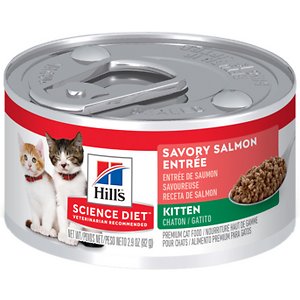
Purr-pare your kitten for plenty of pouncing with Hill’s Science Diet Kitten Savory Salmon Entrée Canned Cat Food—packed with the nutrition his muscles and bones need to grow up into a big strong kitty! The recipe has natural, lean protein to support his muscles and balanced minerals to help his teeth and bones. With antioxidants and vitamins, it’s also good for his immune health. The easy-to-digest recipe has plenty of fiber to support his belly and help make litterbox cleanup easier for you. It’s available in a variety of flavor options so you can surprise your kitty’s taste buds!
Price Score: 62 out of 100 Points
Variety Score: 81 out of 100 Points
Brand Score: 42.5 out of 100 Points
Ingredients Score: 61 out of 100 Points
Total Score: 63.9 out of 100 Points
Key Benefits
- Soft wet food formulated for your young cat that’s the purr-fect combination of essential nutrition and savory taste with real ingredients like salmon.
- Plenty of lean protein to support his muscles.
- Easy-to-digest recipe with natural fiber to support your kitty’s entire digestive system.
- Helps support his immune system with antioxidants and vitamins C and E—balanced minerals help his teeth and bones
- Available in other flavors so your kitty can enjoy variety and find his fur-avorite.
Ingredients
Water, Pork Liver, Salmon, Pork By-Products, Chicken Fat, Egg Product, Soybean Meal, Corn Starch, Soy Protein Isolate, Chicken Liver Flavor, Wheat Flour, Dicalcium Phosphate, Natural Flavor, Powdered Cellulose, Calcium Sulfate, Guar Gum, Brewers Dried Yeast, Potassium Chloride, Iodized Salt, Choline Chloride, Locust Bean Gum, Carrageenan, Taurine, vitamins (Vitamin E Supplement, L-Ascorbyl-2-Polyphosphate (source of Vitamin C), Thiamine Mononitrate, Niacin Supplement, Calcium Pantothenate, Vitamin B12 Supplement, Pyridoxine Hydrochloride, Biotin, Riboflavin Supplement, Folic Acid), minerals (Ferrous Sulfate, Zinc Oxide, Copper Sulfate, Manganese Sulfate, Calcium Iodate), Magnesium Oxide, Beta-Carotene. Caloric Content 203 kcal/ 5.5 oz canSee products with the same ingredients:
-
Biotin - Harmless ingredient
(242)
Biotin also called vitamin H, vitamin B7 or vitamin B8 is a water-soluble B vitamin. It is involved in a wide range of metabolic processes, both in humans and in other organisms, primarily related to the utilization of fats, carbohydrates, and amino acids.
-
Brewers Dried Yeast (36)
-
Calcium Iodate - Controversial ingredient
(126)
-
Calcium Pantothenate - Controversial ingredient
(135)
-
Calcium Sulfate (24)
Calcium sulfate is the inorganic compound with the formula CaSO4 and related hydrates. In the form of γ-anhydrite, it is used as a desiccant. One particular hydrate is better known as plaster of Paris, and another occurs naturally as the mineral gypsum.
-
Carrageenan - Low-quality ingredient
(36)
Carrageenans or carrageenins are a family of linear sulfated polysaccharides that are extracted from red edible seaweeds. They are widely used in the food industry, for their gelling, thickening, and stabilizing properties. Their main application is in dairy and meat products, due to their strong binding to food proteins.
-
Chicken Fat - Healthy ingredient
(71)
Chicken fat is fat obtained from chicken rendering and processing. Of the many animal-sourced substances, chicken fat is noted for being high in linoleic acid, an omega-6 fatty acid. Linoleic acid levels are between 17.9% and 22.8%. It is a common flavoring, additive or main component of chicken soup.
-
Chicken Liver Flavor (14)
-
Choline Chloride - Harmless ingredient
(236)
Choline chloride is an organic compound with the formula 3NCH2CH2OH]Cl. It is bifunctional, containing both quaternary ammonium salt and an alcohol. The cation is choline, which occurs naturally. It is a white, water-soluble salt used mainly in animal feed..
-
Copper Sulfate - Harmless ingredient
(159)
Copper sulfate, also known as copper sulphate, are the inorganic compounds with the chemical formula CuSO4x, where x can range from 0 to 5. The pentahydrate is the most common form. Older names for this compound include blue vitriol, bluestone, vitriol of copper, and Roman vitriol.
-
Corn Starch (21)
Corn starch or maize starch is the starch derived from the corn grain. The starch is obtained from the endosperm of the kernel. Corn starch is a common food ingredient, used in thickening sauces or soups, and in making corn syrup and other sugars.
-
Dicalcium Phosphate - Harmful ingredient
(68)
-
Egg Product (10)
-
Ferrous Sulfate - Harmless ingredient
(166)
Iron sulfate sulphate) or ferrous sulfate denotes a range of salts with the formula FeSO4·xH2O. These compounds exist most commonly as the heptahydrate but are known for several values of x. The hydrated form is used medically to treat iron deficiency, and also for industrial applications.
-
Folic Acid - Harmless ingredient
(235)
Folate, also known as vitamin B9 and folacin, is one of the B vitamins. Manufactured folic acid, which is converted into folate by the body, is used as a dietary supplement and in food fortification as it is more stable during processing and storage.
-
Guar Gum - Controversial ingredient
(69)
Guar gum, also called guaran, is a galactomannan polysaccharide extracted from guar beans that has thickening and stabilizing properties useful in food, feed, and industrial applications. The guar seeds are mechanically dehusked, hydrated, milled and screened according to application. It is typically produced as a free-flowing, off-white powder..
-
Iodized Salt (11)
Iodised salt is table salt mixed with a minute amount of various salts of the element iodine. The ingestion of iodine prevents iodine deficiency. Worldwide, iodine deficiency affects about two billion people and is the leading preventable cause of intellectual and developmental disabilities.
-
Locust Bean Gum (9)
-
Magnesium Oxide (13)
Magnesium oxide, or magnesia, is a white hygroscopic solid mineral that occurs naturally as periclase and is a source of magnesium. It has an empirical formula of MgO and consists of a lattice of Mg2+ ions and O2− ions held together by ionic bonding.
-
Manganese Sulfate - Controversial ingredient
(138)
-
Natural Flavor - Controversial ingredient
(106)
-
Niacin - Harmless ingredient
(238)
Niacin, also known as nicotinic acid, is an organic compound and a form of vitamin B3, an essential human nutrient. It has the formula C 6H 5NO 2 and belongs to the group of the pyridinecarboxylic acid. Niacin is obtained in the diet from a variety of whole and processed foods, with highest contents in fortified packaged foods, tuna, salmon, some vegetable and other animal sources.
-
Pork By-Products (3)
-
Pork Liver (16)
-
Potassium Chloride - Low-quality ingredient
(208)
Potassium chloride is a metal halide salt composed of potassium and chlorine. It is odorless and has a white or colorless vitreous crystal appearance. The solid dissolves readily in water, and its solutions have a salt-like taste. KCl is used as a fertilizer, in medicine, in scientific applications, and in food processing, where it may be known as E number additive E508.
-
Powdered Cellulose (35)
-
Pyridoxine Hydrochloride - Harmless ingredient
(238)
-
Riboflavin - Harmless ingredient
(244)
Riboflavin, also known as vitamin B2, is a vitamin found in food and used as a dietary supplement. Food sources include eggs, green vegetables, milk and other dairy product, meat, mushrooms, and almonds. Some countries require its addition to grains. As a supplement it is used to prevent and treat riboflavin deficiency and prevent migraines.
-
Salmon (25)
Salmon is the common name for several species of ray-finned fish in the family Salmonidae. Other fish in the same family include trout, char, grayling and whitefish. Salmon are native to tributaries of the North Atlantic and Pacific Ocean.
-
Soy Protein Isolate (7)
-
Soybean Meal (22)
-
Taurine - Healthy ingredient
(151)
Taurine, or 2-aminoethanesulfonic acid, is an organic compound that is widely distributed in animal tissues. It is a major constituent of bile and can be found in the large intestine, and accounts for up to 0.1% of total human body weight.
-
Thiamine Mononitrate - Harmless ingredient
(256)
-
Vitamin B12 - Harmless ingredient
(257)
Vitamin B12, also known as cobalamin, is a water-soluble vitamin involved in the metabolism of every cell of the human body: it is a cofactor in DNA synthesis, and in both fatty acid and amino acid metabolism. It is particularly important in the normal functioning of the nervous system via its role in the synthesis of myelin, and in the maturation of developing red blood cells in the bone marrow.
-
Vitamin C - Harmless ingredient
(60)
Vitamin C, also known as ascorbic acid and ascorbate, is a vitamin found in various foods and sold as a dietary supplement. It is used to prevent and treat scurvy. Vitamin C is an essential nutrient involved in the repair of tissue and the enzymatic production of certain neurotransmitters.
-
Vitamin E - Harmless ingredient
(283)
Vitamin E is a group of eight fat soluble compounds that include four tocopherols and four tocotrienols. Vitamin E deficiency, which is rare and usually due to an underlying problem with digesting dietary fat rather than from a diet low in vitamin E, can cause nerve problems.
-
Water (68)
Water is an inorganic, transparent, tasteless, odorless, and nearly colorless chemical substance, which is the main constituent of Earth's hydrosphere and the fluids of most living organisms. It is vital for all known forms of life, even though it provides no calories or organic nutrients.
-
Wheat Flour (34)
Wheat flour is a powder made from the grinding of wheat used for human consumption. Wheat varieties are called "soft" or "weak" if gluten content is low, and are called "hard" or "strong" if they have high gluten content. Hard flour, or bread flour, is high in gluten, with 12% to 14% gluten content, and its dough has elastic toughness that holds its shape well once baked.
-
Zinc Oxide - Harmful ingredient
(65)
Zinc oxide is an inorganic compound with the formula ZnO. ZnO is a white powder that is insoluble in water, and it is widely used as an additive in numerous materials and products including rubbers, plastics, ceramics, glass, cement, lubricants, paints, ointments, adhesives, sealants, pigments, foods, batteries, ferrites, fire retardants, and first-aid tapes.