Compare Prices To Find The Lowest Price

Description
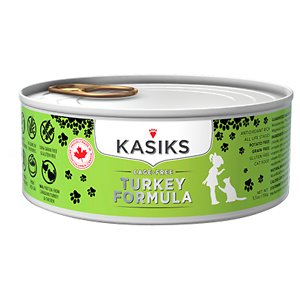
Keep things simple, delicious, and nutritious with the KASIKS Cage-Free Turkey Formula Canned Cat Food. From the family-owned and operated company, the limited-ingredient recipe is specially crafted to nourish your cat. Starting with cage-free turkey and chicken to appeal to his protein-loving appetite, the addition of coconut, kale, and berries offer vital antioxidants. The result is complete and balanced diet full of vitamins and minerals that is good for all life stages, and it’s totally free of grain, gluten, and potato.
Price Score: 59 out of 100 Points
Variety Score: 26 out of 100 Points
Brand Score: 76 out of 100 Points
Ingredients Score: 65 out of 100 Points
Total Score: 58.8 out of 100 Points
Key Benefits
- Family-owned and operated company uses state-of-the-art and BPA-free cannery and oversees all production.
- Coconut, kale, and berries add antioxidants for complete and balanced nutrition, plus vitamins and taurine.
- Limited-ingredient recipe is free from gums, thickeners, grain, gluten, and potatoes.
- Proudly uses cage-free, boneless turkey and chicken free of added hormones as the number one ingredient.
- Uses only the highest-quality ingredients for tasty recipes suited for all life stages.
Ingredients
Boneless Turkey, Water Sufficient For Processing, Pea Starch, Chicken Liver, Sodium Chloride, Calcium Carbonate, Dicalcium Phosphate, Potassium Chloride, Choline Chloride, Taurine, Kale, Minerals: (Zinc Proteinate, Iron Proteinate, Copper Proteinate, Manganese Proteinate, Calcium Iodate), Vitamins, (Vitamin E Supplement, Niacin, Vitamin A Supplement, Thiamine Mononitrate, Riboflavin, Biotin, Vitamin B12 Supplement, D-Pantothenic Acid, Folic Acid, Vitamin D3 Supplement), Blueberries, Raspberries, Cranberries, Coconut. Caloric Content 146 kcal/canSee products with the same ingredients:
-
Biotin - Harmless ingredient
(242)
Biotin also called vitamin H, vitamin B7 or vitamin B8 is a water-soluble B vitamin. It is involved in a wide range of metabolic processes, both in humans and in other organisms, primarily related to the utilization of fats, carbohydrates, and amino acids.
-
Blueberries (34)
Blueberries are perennial flowering plants with blue or purple–colored berries. They are classified in the section Cyanococcus within the genus Vaccinium. Vaccinium also includes cranberries, bilberries, huckleberries and Madeira blueberries. Commercial "blueberries" – including both wild and cultivated blueberries – are all native to North America.
-
Boneless Turkey (1)
-
Calcium Carbonate - Harmless ingredient
(155)
Calcium carbonate is a chemical compound with the formula CaCO3. It is a common substance found in rocks as the minerals calcite and aragonite and is the main component of pearls and the shells of marine organisms, snails, and eggs.
-
Calcium Iodate - Controversial ingredient
(126)
-
Chicken Liver - Healthy ingredient
(38)
-
Choline Chloride - Harmless ingredient
(236)
Choline chloride is an organic compound with the formula 3NCH2CH2OH]Cl. It is bifunctional, containing both quaternary ammonium salt and an alcohol. The cation is choline, which occurs naturally. It is a white, water-soluble salt used mainly in animal feed..
-
Copper Proteinate - Controversial ingredient
(89)
-
Cranberries (34)
The cranberry is a group of evergreen dwarf shrubs, bearing the fruit named after such. Cranberry may also refer to:.
-
D-Pantothenic Acid (3)
-
Dicalcium Phosphate - Harmful ingredient
(68)
-
Folic Acid - Harmless ingredient
(235)
Folate, also known as vitamin B9 and folacin, is one of the B vitamins. Manufactured folic acid, which is converted into folate by the body, is used as a dietary supplement and in food fortification as it is more stable during processing and storage.
-
Iron Proteinate - Controversial ingredient
(68)
-
Kale (8)
Kale or leaf cabbage is one of certain cultivars of cabbage grown for their edible leaves, although some are used as ornamentals. Kale plants have green or purple leaves, and the central leaves do not form a head.
-
Manganese Proteinate - Controversial ingredient
(78)
-
Niacin - Harmless ingredient
(238)
Niacin, also known as nicotinic acid, is an organic compound and a form of vitamin B3, an essential human nutrient. It has the formula C 6H 5NO 2 and belongs to the group of the pyridinecarboxylic acid. Niacin is obtained in the diet from a variety of whole and processed foods, with highest contents in fortified packaged foods, tuna, salmon, some vegetable and other animal sources.
-
Pea Starch (9)
-
Potassium Chloride - Low-quality ingredient
(208)
Potassium chloride is a metal halide salt composed of potassium and chlorine. It is odorless and has a white or colorless vitreous crystal appearance. The solid dissolves readily in water, and its solutions have a salt-like taste. KCl is used as a fertilizer, in medicine, in scientific applications, and in food processing, where it may be known as E number additive E508.
-
Raspberries (6)
The raspberry is the edible fruit of a multitude of plant species in the genus Rubus of the rose family, most of which are in the subgenus Idaeobatus; the name also applies to these plants themselves. Raspberries are perennial with woody stems..
-
Riboflavin - Harmless ingredient
(244)
Riboflavin, also known as vitamin B2, is a vitamin found in food and used as a dietary supplement. Food sources include eggs, green vegetables, milk and other dairy product, meat, mushrooms, and almonds. Some countries require its addition to grains. As a supplement it is used to prevent and treat riboflavin deficiency and prevent migraines.
-
Sodium Chloride (9)
Sodium chloride, commonly known as salt, is an ionic compound with the chemical formula NaCl, representing a 1:1 ratio of sodium and chloride ions. With molar masses of 22.99 and 35.45 g/mol respectively, 100 g of NaCl contains 39.34 g Na and 60.66 g Cl.
-
Taurine - Healthy ingredient
(151)
Taurine, or 2-aminoethanesulfonic acid, is an organic compound that is widely distributed in animal tissues. It is a major constituent of bile and can be found in the large intestine, and accounts for up to 0.1% of total human body weight.
-
Thiamine Mononitrate - Harmless ingredient
(256)
-
Vitamin A - Harmless ingredient
(215)
Vitamin A is a group of unsaturated nutritional organic compounds that includes retinol, retinal, retinoic acid, and several provitamin A carotenoids. Vitamin A has multiple functions: it is important for growth and development, for the maintenance of the immune system, and for good vision.
-
Vitamin B12 - Harmless ingredient
(257)
Vitamin B12, also known as cobalamin, is a water-soluble vitamin involved in the metabolism of every cell of the human body: it is a cofactor in DNA synthesis, and in both fatty acid and amino acid metabolism. It is particularly important in the normal functioning of the nervous system via its role in the synthesis of myelin, and in the maturation of developing red blood cells in the bone marrow.
-
Vitamin D3 - Harmless ingredient
(244)
Cholecalciferol, also known as vitamin D3 and colecalciferol, is a type of vitamin D which is made by the skin when exposed to sunlight; it is also found in some foods and can be taken as a dietary supplement. It is used to treat and prevent vitamin D deficiency and associated diseases, including rickets.
-
Vitamin E - Harmless ingredient
(283)
Vitamin E is a group of eight fat soluble compounds that include four tocopherols and four tocotrienols. Vitamin E deficiency, which is rare and usually due to an underlying problem with digesting dietary fat rather than from a diet low in vitamin E, can cause nerve problems.
-
Water (68)
Water is an inorganic, transparent, tasteless, odorless, and nearly colorless chemical substance, which is the main constituent of Earth's hydrosphere and the fluids of most living organisms. It is vital for all known forms of life, even though it provides no calories or organic nutrients.
-
Zinc Proteinate - Controversial ingredient
(79)
Guaranteed Analysis
| Crude Protein | 10.0% (min) |
|---|---|
| Crude Fat | 5.0% (min) |
| Crude Fiber | 0.2% (max) |
| Moisture | 78.0% (max) |
| Taurine | 0.05% (min) |
| Ash | 2.2% (max) |
| Calcium | 0.3.0% (min) |
| Phosphorous | 0.22% (min) |
| Magnesium | 0.02% (max) |
Dry Matter Basis
| Crude Protein | 45.5% |
|---|---|
| Crude Fat | 22.7% |
| Crude Fiber | 0.9% |
| Moisture | 354.5% |