Compare Prices To Find The Lowest Price


Description
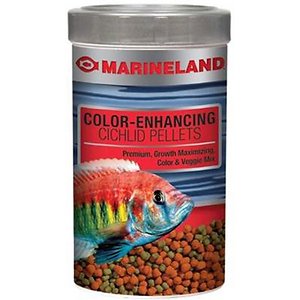
Marineland Color-Enhancing Cichlid Pellet Fish Food combines smart design with superior performance for premium nutrition and water care. This highly nutritious, colorful floating pellet blend includes green veggie pellets that are loaded with healthy spirulina algae meal and red color pellets rich in natural carotenoids. The combination promotes optimal growth in Cichlids as well as clear water for a healthy aquatic environment.
Price Score: 89 out of 100 Points
Variety Score: 26 out of 100 Points
Brand Score: 89 out of 100 Points
Ingredients Score: 65 out of 100 Points
Total Score: 68.8 out of 100 Points
Key Benefits
- Made with a blend of high-protein Peruvian anchovies
- Green veggie pellets are packed with healthy spirulina algae meal
- Red color pellets are mega rich in natural carotenoids
- Highly nutritious, colorful floating pellet blend promotes optimal growth in Cichlids as well as clear water for a healthy aquatic environment
- Combines smart design with superior performance for premium nutrition and water care
Ingredients
Wheat Flour, Dried Anchovy, Condensed Fish Protein Digest (Sourced from Cod, Haddock, Halibut, Herring, Pollack, Mackerel, Whiting, Red Fish), Wheat Gluten, Corn Gluten, Potato Protein, Shrimp Meal, Wheat Germ Meal, Dried Yeast, Feeding Oat Meal, Dehulled Soybean Meal, Corn Starch, Monobasic Calcium Phosphate, Soybean Oil, Algae Meal, Lecithin, L-Lysine Monohydrochloride, Yeast Extract, Riboflavin-5-Phosphate (Source of Vitamin B2), Ascorbic Acid (Source of Vitamin C), Inositol, A-Tocopherol Acetate (Source of Vitamin E), L-Ascorbyl-2-Polyphosphate (Stabilized Vitamin C), Niacin, D-Calcium Pantothenate, Thiamine Mononitrate (Source of Vitamin B1), Pyridoxine Hydrochloride (Source of Vitamin B6), Vitamin A Palmitate (Source of Vitamin A), Folic Acid, Menadione, Sodium Bisulfite Complex (Source of Vitamin K), Biotin, Vitamin B12 Supplement, Cholecalciferol (Source of Vitamin D3), Manganese Sulfate, Zinc Sulfate, Ferrous Sulfate, Cobalt Acetate. Added Color: Beta-Carotene, Annatto Extract, Yellow 5 Lake, Iron Oxide Red, Canthaxanthin, Blue 2 Lake, Ethoxyquin and Citric Acid (Both As Preservatives).See products with the same ingredients:
-
Algae Meal (9)
-
Annatto Extract (2)
-
Biotin - Harmless ingredient
(242)
Biotin also called vitamin H, vitamin B7 or vitamin B8 is a water-soluble B vitamin. It is involved in a wide range of metabolic processes, both in humans and in other organisms, primarily related to the utilization of fats, carbohydrates, and amino acids.
-
Blue (15)
Blue is one of the three primary colours of pigments in painting and traditional colour theory, as well as in the RGB colour model. It lies between violet and green on the spectrum of visible light. The eye perceives blue when observing light with a dominant wavelength between approximately 450 and 495 nanometres.
-
Canthaxanthin (8)
Canthaxanthin is a keto-carotenoid pigment widely distributed in nature. Carotenoids belong to a larger class of phytochemicals known as terpenoids. The chemical formula of canthaxanthin is C40H52O2. It was first isolated in edible mushrooms. It has also been found in green algae, bacteria, crustaceans, and bioaccumulates in fish such as carp, golden mullet, seabream and trush wrasse.
-
Citric Acid - Controversial ingredient
(61)
Citric acid is a weak organic acid that has the chemical formula C 6H 8O 7. It occurs naturally in citrus fruits. In biochemistry, it is an intermediate in the citric acid cycle, which occurs in the metabolism of all aerobic organisms.
-
Cobalt Acetate (3)
-
Condensed Fish Protein Digest Sourced (2)
-
Corn Gluten (3)
-
Corn Starch (21)
Corn starch or maize starch is the starch derived from the corn grain. The starch is obtained from the endosperm of the kernel. Corn starch is a common food ingredient, used in thickening sauces or soups, and in making corn syrup and other sugars.
-
D-Calcium Pantothenate - Controversial ingredient
(110)
-
Dehulled Soybean Meal (10)
-
Dried Anchovy (2)
-
Dried Yeast (20)
-
Ethoxyquin (11)
Ethoxyquin is a quinoline-based antioxidant used as a food preservative in certain countries and originally to control scald on pears after harvest. It is used as a preservative in some pet foods to slow the development of rancidity of fats.
-
Feeding Oat Meal (3)
-
Ferrous Sulfate - Harmless ingredient
(166)
Iron sulfate sulphate) or ferrous sulfate denotes a range of salts with the formula FeSO4·xH2O. These compounds exist most commonly as the heptahydrate but are known for several values of x. The hydrated form is used medically to treat iron deficiency, and also for industrial applications.
-
Folic Acid - Harmless ingredient
(235)
Folate, also known as vitamin B9 and folacin, is one of the B vitamins. Manufactured folic acid, which is converted into folate by the body, is used as a dietary supplement and in food fortification as it is more stable during processing and storage.
-
Haddock (2)
The haddock is a saltwater fish from the family Gadidae, the true cods. It is the only species in the monotypic genus Melanogrammus. It is found in the North Atlantic Ocean and associated seas where it is an important species for fisheries, especially in northern Europe where it is marketed fresh, frozen and smoked; smoked varieties include the Finnan haddie and the Arbroath smokie..
-
Halibut (2)
Halibut is a common name principally applied to the two flatfish in the genus Hippoglossus from the family of right-eye flounders. Less commonly, and in some regions only, other species of flatfish are also referred to as being halibuts. The word is derived from haly and butte, for its popularity on Catholic holy days.
-
Herring (6)
Herring Herring are forage fish, mostly belonging to the family Clupeidae. Herring often move in large schools around fishing banks and near the coast. The most abundant and commercially important species belong to the genus Clupea, found particularly in shallow, temperate waters of the North Pacific and North Atlantic Oceans, including the Baltic Sea, as well as off the west coast of South America.
-
Inositol (34)
Inositol, or more precisely myo-inositol, is a carbocyclic sugar that is abundant in brain and other mammalian tissues, mediates cell signal transduction in response to a variety of hormones, neurotransmitters and growth factors and participates in osmoregulation. It is a sugar alcohol with half the sweetness of sucrose.
-
Iron Oxide Red (1)
-
L-Lysine Monohydrochloride (19)
-
Lecithin - Harmless ingredient
(41)
Lecithin is a generic term to designate any group of yellow-brownish fatty substances occurring in animal and plant tissues which are amphiphilic – they attract both water and fatty substances, and are used for smoothing food textures, emulsifying, homogenizing liquid mixtures, and repelling sticking materials.
-
Mackerel (8)
Mackerel Mackerel is a common name applied to a number of different species of pelagic fish, mostly from the family Scombridae. They are found in both temperate and tropical seas, mostly living along the coast or offshore in the oceanic environment.
-
Manganese Sulfate - Controversial ingredient
(138)
-
Menadione (3)
Menadione is an organic compound with the formula C6H42C2H. It is an analog of 1,4-naphthoquinone with a methyl group in the 2-position. It is occasionally used as a nutritional supplement in animal feed because of its vitamin K activity..
-
Monobasic Calcium Phosphate (6)
-
Niacin - Harmless ingredient
(238)
Niacin, also known as nicotinic acid, is an organic compound and a form of vitamin B3, an essential human nutrient. It has the formula C 6H 5NO 2 and belongs to the group of the pyridinecarboxylic acid. Niacin is obtained in the diet from a variety of whole and processed foods, with highest contents in fortified packaged foods, tuna, salmon, some vegetable and other animal sources.
-
Pollack (2)
Pollack may refer to: Pollack, a surname Pollack or pollock Pollack, a German card game resembling Tresette Pollack Sei whale or pollack whale.
-
Potato Protein (18)
-
Red Fish (2)
Red Fish is an album by the Northern Irish rock band The Moondogs, released in 2003..
-
Shrimp Meal (9)
-
Soybean Oil (29)
-
Vitamin A - Harmless ingredient
(215)
Vitamin A is a group of unsaturated nutritional organic compounds that includes retinol, retinal, retinoic acid, and several provitamin A carotenoids. Vitamin A has multiple functions: it is important for growth and development, for the maintenance of the immune system, and for good vision.
-
Vitamin B1 (11)
Thiamine, also known as thiamin or vitamin B1, is a vitamin found in food, and manufactured as a dietary supplement and medication. Food sources of thiamine include whole grains, legumes, and some meats and fish. Grain processing removes much of the thiamine content, so in many countries cereals and flours are enriched with thiamine.
-
Vitamin B12 - Harmless ingredient
(257)
Vitamin B12, also known as cobalamin, is a water-soluble vitamin involved in the metabolism of every cell of the human body: it is a cofactor in DNA synthesis, and in both fatty acid and amino acid metabolism. It is particularly important in the normal functioning of the nervous system via its role in the synthesis of myelin, and in the maturation of developing red blood cells in the bone marrow.
-
Vitamin B2 (10)
Riboflavin, also known as vitamin B2, is a vitamin found in food and used as a dietary supplement. Food sources include eggs, green vegetables, milk and other dairy product, meat, mushrooms, and almonds. Some countries require its addition to grains. As a supplement it is used to prevent and treat riboflavin deficiency and prevent migraines.
-
Vitamin B6 (16)
Vitamin B6 refers to a group of chemically similar compounds which can be interconverted in biological systems. Vitamin B6 is part of the vitamin B group of essential nutrients. Its active form, pyridoxal 5′-phosphate, serves as a coenzyme in some 100 enzyme reactions in amino acid, glucose, and lipid metabolism..
-
Vitamin C - Harmless ingredient
(60)
Vitamin C, also known as ascorbic acid and ascorbate, is a vitamin found in various foods and sold as a dietary supplement. It is used to prevent and treat scurvy. Vitamin C is an essential nutrient involved in the repair of tissue and the enzymatic production of certain neurotransmitters.
-
Vitamin D3 - Harmless ingredient
(244)
Cholecalciferol, also known as vitamin D3 and colecalciferol, is a type of vitamin D which is made by the skin when exposed to sunlight; it is also found in some foods and can be taken as a dietary supplement. It is used to treat and prevent vitamin D deficiency and associated diseases, including rickets.
-
Vitamin E - Harmless ingredient
(283)
Vitamin E is a group of eight fat soluble compounds that include four tocopherols and four tocotrienols. Vitamin E deficiency, which is rare and usually due to an underlying problem with digesting dietary fat rather than from a diet low in vitamin E, can cause nerve problems.
-
Vitamin K (16)
Vitamin K is a group of structurally similar, fat-soluble vitamins found in foods and in dietary supplements. The human body requires vitamin K for complete synthesis of certain proteins that are needed for blood coagulation or for controlling binding of calcium in bones and other tissues.
-
Wheat Flour (34)
Wheat flour is a powder made from the grinding of wheat used for human consumption. Wheat varieties are called "soft" or "weak" if gluten content is low, and are called "hard" or "strong" if they have high gluten content. Hard flour, or bread flour, is high in gluten, with 12% to 14% gluten content, and its dough has elastic toughness that holds its shape well once baked.
-
Wheat Germ Meal (4)
-
Wheat Gluten - Controversial ingredient
(46)
-
Whiting (2)
Whiting is the name of powdered and washed white chalk, used in metal polish, putty, and whitewash, and sometimes added to paint to improve the paint's opacity.
-
Yeast Extract (16)
Yeast extracts consist of the cell contents of yeast without the cell walls; they are used as food additives or flavorings, or as nutrients for bacterial culture media. They are often used to create savory flavors and umami taste sensations, and can be found in a large variety of packaged food, including frozen meals, crackers, snack foods, gravy, stock and more.
-
Yellow (22)
Yellow is the color between orange and green on the spectrum of visible light. It is evoked by light with a dominant wavelength of roughly 570–590 nm. It is a primary color in subtractive color systems, used in painting or color printing.
-
Zinc Sulfate - Low-quality ingredient
(132)
Zinc sulfate is an inorganic compound and dietary supplement. As a supplement it is used to treat zinc deficiency and to prevent the condition in those at high risk. Side effects of excess supplementation may include abdominal pain, vomiting, headache, and tiredness.
Guaranteed Analysis
| Crude Protein | 46.0% min |
|---|---|
| Crude Fat | 7.0% min |
| Crude Fiber | 2.0% max |
| Moisture | 8.0% max |
| Phosphorus | 1.0% min |
| Ascorbic Acid | 280 mg/kg min |
Dry Matter Basis
| Crude Protein | 50.0% |
|---|---|
| Crude Fat | 7.6% |
| Crude Fiber | 2.2% |
| Moisture | 8.7% |