Compare Prices To Find The Lowest Price



Description
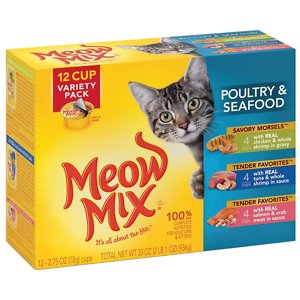
Your cat can dine on a different delicacy every night with Meow Mix Poultry & Seafood Variety Pack Canned Cat Food. This variety pack features 12 cups of these favorite feasts: Savory Morsels with Real Chicken & Whole Shrimp in Sauce (4), Tender Favorites with Real Tuna & Whole Shrimp in Sauce (4), Tender Favorites with Real Salmon & Crab Meat in Sauce (4). Open up a cup and treat your favorite feline to tender pieces of real chicken, salmon or tuna in a savory sauce. Meow Mix meals are made with wholesome ingredients and are so tasty, cats ask for them by name.
Price Score: 88 out of 100 Points
Variety Score: 49 out of 100 Points
Brand Score: 90 out of 100 Points
Ingredients Score: 63 out of 100 Points
Total Score: 75 out of 100 Points
Key Benefits
- 12-cup variety pack of three favorite meals
- Made with real chicken, salmon and tuna for a unique combination of flavors
- Made with high-quality animal proteins plus vitamins and minerals
- Fortified with essential vitamins and minerals
- 100% complete and balanced for adult cats and kittens
Ingredients
Savory Morsels with Real Chicken & Whole Shrimp In Sauce: Fish Broth, Chicken, Wheat Gluten, Tuna, Modified Tapioca Starch, Chicken Liver, Shrimp, Sugar, Chicken Fat, Dried Egg Product, Calcium Sulfate, Titanium Dioxide (Color), Salt, Potassium Chloride, Natural & Artificial Flavors, Tricalcium Phosphate, Guar Gum, Sodium Tripolyphosphate, Choline Chloride, Taurine, Vitamins (Vitamin E Supplement, Niacin, Thiamine Mononitrate, Vitamin A Supplement, Pantothenic Acid, Riboflavin Supplement, Pyridoxine Hydrochloride (Vitamin B6), Biotin, Vitamin D3 Supplement, Vitamin B12 Supplement, Folic Acid, Menadione Sodium Bisulfite Complex (Source of Vitamin K Activity)), Minerals (Ferrous Sulfate Monohydrate, Zinc Oxide, Manganese Sulfate Monohydrate, Copper Proteinate, Sodium Selenite, Potassium Iodide), Magnesium Oxide, Canthaxanthin (Color). Tender Favorites with Real Salmon & Crab Meat In Sauce: Tuna, Fish Broth, Sardine, Salmon, Crab, Natural and Artificial Flavors, Vegetable Oil, Tricalcium Phosphate, Guar Gum, Carrageenan, Calcium Sulfate, Salt, Vitamins [Vitamin E Supplement, Niacin, Thiamine Mononitrate, Vitamin A Supplement, Pantothenic Acid, Riboflavin Supplement, Pyridoxine Hydrochloride (Vitamin B6), Biotin, Vitamin D3 Supplement, Vitamin B12 Supplement, Folic Acid, Menadione Sodium Bisulfite Complex (Source of Vitamin K Activity)], Minerals (Ferrous Sulfate Monohydrate, Zinc Oxide, Manganese Sulfate Monohydrate, Copper Proteinate, Sodium Selenite, Potassium Iodide), Annatto Extract (Color), Canthaxanthin (Color), Sodium Nitrite (To Promote Color Retention). Tender Favorites with Real Tuna & Whole Shrimp In Sauce: Tuna, Fish Broth, Ocean Fish, Shrimp, Soybean Oil, Natural & Artificial Flavors, Tricalcium Phosphate, Guar Gum, Carrageenan, Salt, Calcium Sulphate, Vitamins [Vitamin E, Niacin, Thiamine Mononitrate, Vitamin A, Pantothenic Acid, Riboflavin, Pyridoxine Hydrochloride, Biotin, Vitamin D3, Vitamin B12, Folic Acid, Menadione Sodium Bisulphite Complex (Source of Vitamin K Activity)], Minerals (Ferrous Sulphate Monohydrate, Zinc Oxide, Manganese Sulphate Monohydrate, Copper Proteinate, Sodium Selenite, Potassium Iodide), Sodium Nitrite, Color.See products with the same ingredients:
-
Annatto Extract (2)
-
Artificial Flavors (7)
-
Biotin - Harmless ingredient
(242)
Biotin also called vitamin H, vitamin B7 or vitamin B8 is a water-soluble B vitamin. It is involved in a wide range of metabolic processes, both in humans and in other organisms, primarily related to the utilization of fats, carbohydrates, and amino acids.
-
Calcium Sulfate (24)
Calcium sulfate is the inorganic compound with the formula CaSO4 and related hydrates. In the form of γ-anhydrite, it is used as a desiccant. One particular hydrate is better known as plaster of Paris, and another occurs naturally as the mineral gypsum.
-
Calcium Sulphate (1)
Calcium sulfate is the inorganic compound with the formula CaSO4 and related hydrates. In the form of γ-anhydrite, it is used as a desiccant. One particular hydrate is better known as plaster of Paris, and another occurs naturally as the mineral gypsum.
-
Canthaxanthin (8)
Canthaxanthin is a keto-carotenoid pigment widely distributed in nature. Carotenoids belong to a larger class of phytochemicals known as terpenoids. The chemical formula of canthaxanthin is C40H52O2. It was first isolated in edible mushrooms. It has also been found in green algae, bacteria, crustaceans, and bioaccumulates in fish such as carp, golden mullet, seabream and trush wrasse.
-
Carrageenan - Low-quality ingredient
(36)
Carrageenans or carrageenins are a family of linear sulfated polysaccharides that are extracted from red edible seaweeds. They are widely used in the food industry, for their gelling, thickening, and stabilizing properties. Their main application is in dairy and meat products, due to their strong binding to food proteins.
-
Chicken - Healthy ingredient
(141)
The chicken is a type of domesticated fowl, a subspecies of the red junglefowl. They are one of the most common and widespread domestic animals, with a total population of 23.7 billion as of 2018, up from more than 19 billion in 2011.
-
Chicken Fat - Healthy ingredient
(71)
Chicken fat is fat obtained from chicken rendering and processing. Of the many animal-sourced substances, chicken fat is noted for being high in linoleic acid, an omega-6 fatty acid. Linoleic acid levels are between 17.9% and 22.8%. It is a common flavoring, additive or main component of chicken soup.
-
Chicken Liver - Healthy ingredient
(38)
-
Choline Chloride - Harmless ingredient
(236)
Choline chloride is an organic compound with the formula 3NCH2CH2OH]Cl. It is bifunctional, containing both quaternary ammonium salt and an alcohol. The cation is choline, which occurs naturally. It is a white, water-soluble salt used mainly in animal feed..
-
Color (3)
Color, or colour, is the characteristic of visual perception described through color categories, with names such as red, orange, yellow, green, blue, or purple. This perception of color derives from the stimulation of photoreceptor cells by electromagnetic radiation.
-
Copper Proteinate - Controversial ingredient
(89)
-
Crab (2)
Crabs are decapod crustaceans of the infraorder Brachyura, which typically have a very short projecting "tail" , usually hidden entirely under the thorax. They live in all the world's oceans, in fresh water, and on land, are generally covered with a thick exoskeleton and have a single pair of pincers.
-
Dried Egg Product - Low-quality ingredient
(37)
-
Ferrous Sulfate Monohydrate (3)
-
Ferrous Sulphate Monohydrate (1)
-
Fish Broth (8)
-
Folic Acid - Harmless ingredient
(235)
Folate, also known as vitamin B9 and folacin, is one of the B vitamins. Manufactured folic acid, which is converted into folate by the body, is used as a dietary supplement and in food fortification as it is more stable during processing and storage.
-
Guar Gum - Controversial ingredient
(69)
Guar gum, also called guaran, is a galactomannan polysaccharide extracted from guar beans that has thickening and stabilizing properties useful in food, feed, and industrial applications. The guar seeds are mechanically dehusked, hydrated, milled and screened according to application. It is typically produced as a free-flowing, off-white powder..
-
Magnesium Oxide (13)
Magnesium oxide, or magnesia, is a white hygroscopic solid mineral that occurs naturally as periclase and is a source of magnesium. It has an empirical formula of MgO and consists of a lattice of Mg2+ ions and O2− ions held together by ionic bonding.
-
Manganese Sulfate Monohydrate (3)
-
Manganese Sulphate Monohydrate (1)
-
Modified Tapioca Starch (5)
-
Natural (9)
Nature, in the broadest sense, is the natural, physical, or material world or universe. "Nature" can refer to the phenomena of the physical world, and also to life in general. The study of nature is a large, if not the only, part of science.
-
Natural Artificial Flavors (5)
-
Niacin - Harmless ingredient
(238)
Niacin, also known as nicotinic acid, is an organic compound and a form of vitamin B3, an essential human nutrient. It has the formula C 6H 5NO 2 and belongs to the group of the pyridinecarboxylic acid. Niacin is obtained in the diet from a variety of whole and processed foods, with highest contents in fortified packaged foods, tuna, salmon, some vegetable and other animal sources.
-
Ocean Fish (3)
-
Pantothenic Acid (8)
Pantothenic acid, also called vitamin B5, is a water-soluble vitamin. Pantothenic acid is an essential nutrient. Animals require pantothenic acid in order to synthesize coenzyme-A, as well as to synthesize and metabolize proteins, carbohydrates, and fats. The anion is called pantothenate.
-
Potassium Chloride - Low-quality ingredient
(208)
Potassium chloride is a metal halide salt composed of potassium and chlorine. It is odorless and has a white or colorless vitreous crystal appearance. The solid dissolves readily in water, and its solutions have a salt-like taste. KCl is used as a fertilizer, in medicine, in scientific applications, and in food processing, where it may be known as E number additive E508.
-
Potassium Iodide - Harmless ingredient
(85)
Potassium iodide is a chemical compound, medication, and dietary supplement. As a medication it is used to treat hyperthyroidism, in radiation emergencies, and to protect the thyroid gland when certain types of radiopharmaceuticals are used. In the developing world it is also used to treat skin sporotrichosis and phycomycosis.
-
Pyridoxine Hydrochloride - Harmless ingredient
(238)
-
Riboflavin - Harmless ingredient
(244)
Riboflavin, also known as vitamin B2, is a vitamin found in food and used as a dietary supplement. Food sources include eggs, green vegetables, milk and other dairy product, meat, mushrooms, and almonds. Some countries require its addition to grains. As a supplement it is used to prevent and treat riboflavin deficiency and prevent migraines.
-
Salmon (25)
Salmon is the common name for several species of ray-finned fish in the family Salmonidae. Other fish in the same family include trout, char, grayling and whitefish. Salmon are native to tributaries of the North Atlantic and Pacific Ocean.
-
Salt - Harmless ingredient
(231)
Salt is a mineral consisting primarily of sodium chloride, a chemical compound belonging to the larger class of salts; salt in its natural form as a crystalline mineral is known as rock salt or halite. Salt is present in vast quantities in seawater, where it is the main mineral constituent.
-
Sardine (1)
Sardines "Sardine" or "pilchard" are common names used to refer to various small, oily forage fish in the herring family Clupeidae. The term "sardine" was first used in English during the early 15th century and may come from the Mediterranean island of Sardinia, around which sardines were once abundant.
-
Shrimp (5)
Shrimp are decapod crustaceans with elongated bodies and a primarily swimming mode of locomotion – most commonly Caridea and Dendrobranchiata. More narrow definitions may be restricted to Caridea, to smaller species of either group or to only the marine species. Under a broader definition, shrimp may be synonymous with prawn, covering stalk-eyed swimming crustaceans with long narrow muscular tails, long whiskers, and slender legs.
-
Sodium Nitrite (11)
Sodium nitrite is an inorganic compound with the chemical formula Na NO2. It is a white to slightly yellowish crystalline powder that is very soluble in water and is hygroscopic. From the industrial perspective, it is the most important nitrite salt.
-
Sodium Selenite - Harmful ingredient
(166)
-
Sodium Tripolyphosphate (34)
-
Soybean Oil (29)
-
Sugar (27)
Sugar is the generic name for sweet-tasting, soluble carbohydrates, many of which are used in food. Simple sugars, also called monosaccharides, include glucose, fructose, and galactose. Compound sugars, also called disaccharides or double sugars, are molecules composed of two monosaccharides joined by a glycosidic bond.
-
Taurine - Healthy ingredient
(151)
Taurine, or 2-aminoethanesulfonic acid, is an organic compound that is widely distributed in animal tissues. It is a major constituent of bile and can be found in the large intestine, and accounts for up to 0.1% of total human body weight.
-
Thiamine Mononitrate - Harmless ingredient
(256)
-
Titanium Dioxide (14)
Titanium dioxide, also known as titanium oxide or titania, is the naturally occurring oxide of titanium, chemical formula TiO 2. When used as a pigment, it is called titanium white, Pigment White 6, or CI 77891. Generally, it is sourced from ilmenite, rutile, and anatase.
-
Tricalcium Phosphate - Controversial ingredient
(46)
Tricalcium phosphate is a calcium salt of phosphoric acid with the chemical formula Ca32. It is also known as tribasic calcium phosphate and bone phosphate of lime. It is a white solid of low solubility. Most commercial samples of "tricalcium phosphate" are in fact hydroxyapatite.
-
Tuna (24)
A tuna is a saltwater fish that belongs to the tribe Thunnini, a subgrouping of the Scombridae family. The Thunnini comprise 15 species across five genera, the sizes of which vary greatly, ranging from the bullet tuna (max. length: 50 cm, weight: 1.8 kg ) up to the Atlantic bluefin tuna (max.
-
Vegetable Oil (25)
Vegetable oils, or vegetable fats, are oils extracted from seeds, or less often, from other parts of fruits. Like animal fats, vegetable fats are mixtures of triglycerides. Soybean oil, rapeseed oil, and cocoa butter are examples of fats from seeds. Olive oil, palm oil, and rice bran oil are examples of fats from other parts of fruits.
-
Vitamin A - Harmless ingredient
(215)
Vitamin A is a group of unsaturated nutritional organic compounds that includes retinol, retinal, retinoic acid, and several provitamin A carotenoids. Vitamin A has multiple functions: it is important for growth and development, for the maintenance of the immune system, and for good vision.
-
Vitamin B12 - Harmless ingredient
(257)
Vitamin B12, also known as cobalamin, is a water-soluble vitamin involved in the metabolism of every cell of the human body: it is a cofactor in DNA synthesis, and in both fatty acid and amino acid metabolism. It is particularly important in the normal functioning of the nervous system via its role in the synthesis of myelin, and in the maturation of developing red blood cells in the bone marrow.
-
Vitamin D3 - Harmless ingredient
(244)
Cholecalciferol, also known as vitamin D3 and colecalciferol, is a type of vitamin D which is made by the skin when exposed to sunlight; it is also found in some foods and can be taken as a dietary supplement. It is used to treat and prevent vitamin D deficiency and associated diseases, including rickets.
-
Vitamin E - Harmless ingredient
(283)
Vitamin E is a group of eight fat soluble compounds that include four tocopherols and four tocotrienols. Vitamin E deficiency, which is rare and usually due to an underlying problem with digesting dietary fat rather than from a diet low in vitamin E, can cause nerve problems.
-
Vitamin K Activity (35)
-
Wheat Gluten - Controversial ingredient
(46)
-
Zinc Oxide - Harmful ingredient
(65)
Zinc oxide is an inorganic compound with the formula ZnO. ZnO is a white powder that is insoluble in water, and it is widely used as an additive in numerous materials and products including rubbers, plastics, ceramics, glass, cement, lubricants, paints, ointments, adhesives, sealants, pigments, foods, batteries, ferrites, fire retardants, and first-aid tapes.
Guaranteed Analysis
| Crude Protein | 8.0% min |
|---|---|
| Crude Fat | 3.5% min |
| Crude Fiber | 1.5% max |
| Moisture | 82.0% max |
| Ash | 3.0% max |
| Taurine | 0.05% min |
Dry Matter Basis
| Crude Protein | 44.4% |
|---|---|
| Crude Fat | 19.4% |
| Crude Fiber | 8.3% |
| Moisture | 455.6% |