Compare Prices To Find The Lowest Price



Description
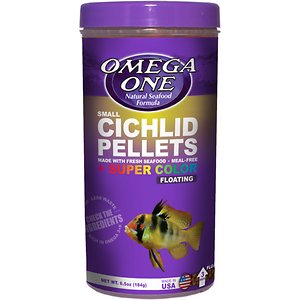
Omega One Small Cichlid Pellets Floating Fish Food offers small, color enhancing floating pellets for your cichlids to thrive on. These pellets contain great nutrition with natural protein and unsurpassed palatability.
Price Score: 66 out of 100 Points
Variety Score: 60 out of 100 Points
Brand Score: 75 out of 100 Points
Ingredients Score: 75 out of 100 Points
Total Score: 68.2 out of 100 Points
Key Benefits
- Offers the ideal balance of fresh seafood and ocean kelp to satisfy cichlid nutrition
- Whole salmon is the first ingredient and features additional quality Alaskan seafood such as halibut, krill, shrimp and more as protein sources
- Fishmeal-free formulation contains guaranteed levels of Omega-3 and -6 fatty acids to support cichlid health, growth, and coloration
- High protein, low in starch, and doesn’t cloud water
- Suitable for a wide variety of cichlids, including South American and rift lake species
Ingredients
Salmon, Whole Herring, Wheat Flour, Wheat Germ, Whole Shrimp, Pea Protein, Kelp, Marigold Extract, Astaxanthin, Canthaxanthin, Potassium Sorbate, Ethoxyquin (Preservative), BHT (Preservative), BHA (Preservative), Natural And Artificial Colors, Ascorbyl Monophosphate (Source Of Vitamin C), Niacin, Inositol, Folic Acid, Biotin, Riboflavin, Pantothenic Acid, Vitamin A Acetate, Vitamin D3 Supplement, Vitamin E Supplement, Vitamin B12 Supplement.See products with the same ingredients:
-
Astaxanthin (5)
Astaxanthin is a keto-carotenoid. It belongs to a larger class of chemical compounds known as terpenes built from five carbon precursors, isopentenyl diphosphate, and dimethylallyl diphosphate. Astaxanthin is classified as a xanthophyll, but currently employed to describe carotenoid compounds that have oxygen-containing components, hydroxyl or ketone, such as zeaxanthin and canthaxanthin.
-
Bha (15)
BHA may refer to:.
-
BHT (9)
-
Biotin - Harmless ingredient
(242)
Biotin also called vitamin H, vitamin B7 or vitamin B8 is a water-soluble B vitamin. It is involved in a wide range of metabolic processes, both in humans and in other organisms, primarily related to the utilization of fats, carbohydrates, and amino acids.
-
Canthaxanthin (8)
Canthaxanthin is a keto-carotenoid pigment widely distributed in nature. Carotenoids belong to a larger class of phytochemicals known as terpenoids. The chemical formula of canthaxanthin is C40H52O2. It was first isolated in edible mushrooms. It has also been found in green algae, bacteria, crustaceans, and bioaccumulates in fish such as carp, golden mullet, seabream and trush wrasse.
-
Ethoxyquin (11)
Ethoxyquin is a quinoline-based antioxidant used as a food preservative in certain countries and originally to control scald on pears after harvest. It is used as a preservative in some pet foods to slow the development of rancidity of fats.
-
Folic Acid - Harmless ingredient
(235)
Folate, also known as vitamin B9 and folacin, is one of the B vitamins. Manufactured folic acid, which is converted into folate by the body, is used as a dietary supplement and in food fortification as it is more stable during processing and storage.
-
Inositol (34)
Inositol, or more precisely myo-inositol, is a carbocyclic sugar that is abundant in brain and other mammalian tissues, mediates cell signal transduction in response to a variety of hormones, neurotransmitters and growth factors and participates in osmoregulation. It is a sugar alcohol with half the sweetness of sucrose.
-
Kelp (7)
Kelps are large brown algae seaweeds that make up the order Laminariales. There are about 30 different genera. Despite its appearance, kelp is not a plant; it is a heterokont. Kelp grows in "underwater forests" in shallow oceans, and is thought to have appeared in the Miocene, 5 to 23 million years ago.
-
Marigold Extract (9)
-
Natural And Artificial Colors (4)
-
Niacin - Harmless ingredient
(238)
Niacin, also known as nicotinic acid, is an organic compound and a form of vitamin B3, an essential human nutrient. It has the formula C 6H 5NO 2 and belongs to the group of the pyridinecarboxylic acid. Niacin is obtained in the diet from a variety of whole and processed foods, with highest contents in fortified packaged foods, tuna, salmon, some vegetable and other animal sources.
-
Pantothenic Acid (8)
Pantothenic acid, also called vitamin B5, is a water-soluble vitamin. Pantothenic acid is an essential nutrient. Animals require pantothenic acid in order to synthesize coenzyme-A, as well as to synthesize and metabolize proteins, carbohydrates, and fats. The anion is called pantothenate.
-
Pea Protein (30)
-
Potassium Sorbate (33)
Potassium sorbate is the potassium salt of sorbic acid, chemical formula CH3CH=CH−CH=CH−CO2K. It is a white salt that is very soluble in water. It is primarily used as a food preservative. Potassium sorbate is effective in a variety of applications including food, wine, and personal-care products.
-
Riboflavin - Harmless ingredient
(244)
Riboflavin, also known as vitamin B2, is a vitamin found in food and used as a dietary supplement. Food sources include eggs, green vegetables, milk and other dairy product, meat, mushrooms, and almonds. Some countries require its addition to grains. As a supplement it is used to prevent and treat riboflavin deficiency and prevent migraines.
-
Salmon (25)
Salmon is the common name for several species of ray-finned fish in the family Salmonidae. Other fish in the same family include trout, char, grayling and whitefish. Salmon are native to tributaries of the North Atlantic and Pacific Ocean.
-
Vitamin A Acetate (33)
-
Vitamin B12 - Harmless ingredient
(257)
Vitamin B12, also known as cobalamin, is a water-soluble vitamin involved in the metabolism of every cell of the human body: it is a cofactor in DNA synthesis, and in both fatty acid and amino acid metabolism. It is particularly important in the normal functioning of the nervous system via its role in the synthesis of myelin, and in the maturation of developing red blood cells in the bone marrow.
-
Vitamin C - Harmless ingredient
(60)
Vitamin C, also known as ascorbic acid and ascorbate, is a vitamin found in various foods and sold as a dietary supplement. It is used to prevent and treat scurvy. Vitamin C is an essential nutrient involved in the repair of tissue and the enzymatic production of certain neurotransmitters.
-
Vitamin D3 - Harmless ingredient
(244)
Cholecalciferol, also known as vitamin D3 and colecalciferol, is a type of vitamin D which is made by the skin when exposed to sunlight; it is also found in some foods and can be taken as a dietary supplement. It is used to treat and prevent vitamin D deficiency and associated diseases, including rickets.
-
Vitamin E - Harmless ingredient
(283)
Vitamin E is a group of eight fat soluble compounds that include four tocopherols and four tocotrienols. Vitamin E deficiency, which is rare and usually due to an underlying problem with digesting dietary fat rather than from a diet low in vitamin E, can cause nerve problems.
-
Wheat Flour (34)
Wheat flour is a powder made from the grinding of wheat used for human consumption. Wheat varieties are called "soft" or "weak" if gluten content is low, and are called "hard" or "strong" if they have high gluten content. Hard flour, or bread flour, is high in gluten, with 12% to 14% gluten content, and its dough has elastic toughness that holds its shape well once baked.
-
Wheat Germ (8)
-
Whole Herring (5)
-
Whole Shrimp (5)
Guaranteed Analysis
| Crude Protein | 35.0% min |
|---|---|
| Crude Fat | 10.0% min |
| Crude Fiber | 3.0% max |
| Moisture | 8.5% max |
| Ash | 8.0% max |
Dry Matter Basis
| Crude Protein | 38.3% |
|---|---|
| Crude Fat | 10.9% |
| Crude Fiber | 3.3% |
| Moisture | 9.3% |