Compare Prices To Find The Lowest Price




Description
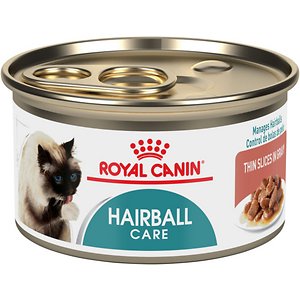
Royal Canin Hairball Care Thin Slices in Gravy Canned Cat Food was developed specifically for your indoor cat over 1 year old. Cats who live exclusively indoors are sheltered from temperature variations and changes in day length which disrupts the natural seasonal cycle of fur growth, so your kitty sheds almost continuously. With a constant shed cycle, your cat swallows excessive hair during grooming and has an increased chance of hairballs. This special formula contains highly digestible proteins to promote digestive health, support hairball management, and maintain an ideal weight. This complete and balanced diet provides all the nutrients your furry friend needs and may be fed alone or as a supplement to another diet.
Price Score: 25 out of 100 Points
Variety Score: 78 out of 100 Points
Brand Score: 89 out of 100 Points
Ingredients Score: 68 out of 100 Points
Total Score: 67 out of 100 Points
Key Benefits
- These tasty slices in gravy are developed specifically for indoor cats over 1 year old.
- Made with highly digestible protein to promote digestive health and wellbeing.
- Supports hairball management and keeps your kitty at an ideal weight.
- 100% complete and balanced nutrition may be fed alone or as a supplement to another diet.
- Keep your indoor furball healthy and hairball free with this formula developed by nutritional experts.
Ingredients
Water Sufficient For Processing, Chicken By-Products, Pork By-Products, Chicken Liver, Pork Liver, Corn Flour, Powdered Cellulose, Modified Corn Starch, Pork Plasma, Natural Flavors, Carob Bean Gum, Sodium Tripolyphosphate, Tricalcium Phosphate, Calcium Carbonate, Potassium Chloride, Hydrolyzed Yeast, Sodium Silico Aluminate, Dl-Methionine, Taurine, Vitamins [Dl-Alpha Tocopherol Acetate (Source Of Vitamin E), Thiamine Mononitrate (Vitamin B1), Niacin Supplement, Biotin, D-Calcium Pantothenate, Pyridoxine Hydrochloride (Vitamin B6), Riboflavin Supplement, Folic Acid, Vitamin B12 Supplement, Vitamin D3 Supplement], Cysteine, Glycine, Sodium Carbonate, Calcium Sulfate, Psyllium Seed Husk, Trace Minerals [Zinc Oxide, Zinc Proteinate, Ferrous Sulfate, Copper Sulfate, Manganous Oxide, Calcium Iodate, Sodium Selenite]. Caloric Content 652 kcal/kg, 55 kcal/canSee products with the same ingredients:
-
Biotin - Harmless ingredient
(242)
Biotin also called vitamin H, vitamin B7 or vitamin B8 is a water-soluble B vitamin. It is involved in a wide range of metabolic processes, both in humans and in other organisms, primarily related to the utilization of fats, carbohydrates, and amino acids.
-
Calcium Carbonate - Harmless ingredient
(155)
Calcium carbonate is a chemical compound with the formula CaCO3. It is a common substance found in rocks as the minerals calcite and aragonite and is the main component of pearls and the shells of marine organisms, snails, and eggs.
-
Calcium Iodate - Controversial ingredient
(126)
-
Calcium Sulfate (24)
Calcium sulfate is the inorganic compound with the formula CaSO4 and related hydrates. In the form of γ-anhydrite, it is used as a desiccant. One particular hydrate is better known as plaster of Paris, and another occurs naturally as the mineral gypsum.
-
Carob Bean Gum (2)
-
Chicken By-products (6)
-
Chicken Liver - Healthy ingredient
(38)
-
Copper Sulfate - Harmless ingredient
(159)
Copper sulfate, also known as copper sulphate, are the inorganic compounds with the chemical formula CuSO4x, where x can range from 0 to 5. The pentahydrate is the most common form. Older names for this compound include blue vitriol, bluestone, vitriol of copper, and Roman vitriol.
-
Corn Flour (6)
-
Cysteine (1)
Cysteine is a semiessential proteinogenic amino acid with the formula HO2CCHCH2SH. The thiol side chain in cysteine often participates in enzymatic reactions, as a nucleophile. The thiol is susceptible to oxidation to give the disulfide derivative cystine, which serves an important structural role in many proteins.
-
D-Calcium Pantothenate - Controversial ingredient
(110)
-
Dl-Methionine - Healthy ingredient
(62)
Methionine is an essential amino acid in humans. As the substrate for other amino acids such as cysteine and taurine, versatile compounds such as SAM-e, and the important antioxidant glutathione, methionine plays a critical role in the metabolism and health of many species, including humans.
-
Ferrous Sulfate - Harmless ingredient
(166)
Iron sulfate sulphate) or ferrous sulfate denotes a range of salts with the formula FeSO4·xH2O. These compounds exist most commonly as the heptahydrate but are known for several values of x. The hydrated form is used medically to treat iron deficiency, and also for industrial applications.
-
Folic Acid - Harmless ingredient
(235)
Folate, also known as vitamin B9 and folacin, is one of the B vitamins. Manufactured folic acid, which is converted into folate by the body, is used as a dietary supplement and in food fortification as it is more stable during processing and storage.
-
Glycine (4)
Glycine is an amino acid that has a single hydrogen atom as its side chain. It is the simplest amino acid, with the chemical formula NH2‐CH2‐COOH. Glycine is one of the proteinogenic amino acids. It is encoded by all the codons starting with GG.
-
Hydrolyzed Yeast (7)
-
Manganous Oxide - Low-quality ingredient
(49)
-
Modified Corn Starch (3)
-
Natural Flavors - Controversial ingredient
(38)
Flavor, flavour, or taste is the perceptual impression of food or other substances, and is determined primarily by the chemical senses of the gustatory and olfactory system. The "trigeminal senses", which detect chemical irritants in the mouth and throat, as well as temperature and texture, are also important to the overall gestalt of flavor perception.
-
Niacin - Harmless ingredient
(238)
Niacin, also known as nicotinic acid, is an organic compound and a form of vitamin B3, an essential human nutrient. It has the formula C 6H 5NO 2 and belongs to the group of the pyridinecarboxylic acid. Niacin is obtained in the diet from a variety of whole and processed foods, with highest contents in fortified packaged foods, tuna, salmon, some vegetable and other animal sources.
-
Pork By-Products (3)
-
Pork Liver (16)
-
Pork Plasma (1)
-
Potassium Chloride - Low-quality ingredient
(208)
Potassium chloride is a metal halide salt composed of potassium and chlorine. It is odorless and has a white or colorless vitreous crystal appearance. The solid dissolves readily in water, and its solutions have a salt-like taste. KCl is used as a fertilizer, in medicine, in scientific applications, and in food processing, where it may be known as E number additive E508.
-
Powdered Cellulose (35)
-
Psyllium Seed Husk (4)
-
Pyridoxine Hydrochloride - Harmless ingredient
(238)
-
Riboflavin - Harmless ingredient
(244)
Riboflavin, also known as vitamin B2, is a vitamin found in food and used as a dietary supplement. Food sources include eggs, green vegetables, milk and other dairy product, meat, mushrooms, and almonds. Some countries require its addition to grains. As a supplement it is used to prevent and treat riboflavin deficiency and prevent migraines.
-
Sodium Carbonate (3)
Sodium carbonate, Na2CO3, is the inorganic compound with the formula Na2CO3 and its various hydrates. All forms are white, water-soluble salts. All forms have a strongly alkaline taste and give moderately alkaline solutions in water. Historically it was extracted from the ashes of plants growing in sodium-rich soils.
-
Sodium Silico Aluminate (3)
-
Sodium Tripolyphosphate (34)
-
Taurine - Healthy ingredient
(151)
Taurine, or 2-aminoethanesulfonic acid, is an organic compound that is widely distributed in animal tissues. It is a major constituent of bile and can be found in the large intestine, and accounts for up to 0.1% of total human body weight.
-
Thiamine Mononitrate - Harmless ingredient
(256)
-
Trace Zinc Oxide (1)
-
Tricalcium Phosphate - Controversial ingredient
(46)
Tricalcium phosphate is a calcium salt of phosphoric acid with the chemical formula Ca32. It is also known as tribasic calcium phosphate and bone phosphate of lime. It is a white solid of low solubility. Most commercial samples of "tricalcium phosphate" are in fact hydroxyapatite.
-
Vitamin B12 - Harmless ingredient
(257)
Vitamin B12, also known as cobalamin, is a water-soluble vitamin involved in the metabolism of every cell of the human body: it is a cofactor in DNA synthesis, and in both fatty acid and amino acid metabolism. It is particularly important in the normal functioning of the nervous system via its role in the synthesis of myelin, and in the maturation of developing red blood cells in the bone marrow.
-
Vitamin D3 - Harmless ingredient
(244)
Cholecalciferol, also known as vitamin D3 and colecalciferol, is a type of vitamin D which is made by the skin when exposed to sunlight; it is also found in some foods and can be taken as a dietary supplement. It is used to treat and prevent vitamin D deficiency and associated diseases, including rickets.
-
Vitamin E - Harmless ingredient
(283)
Vitamin E is a group of eight fat soluble compounds that include four tocopherols and four tocotrienols. Vitamin E deficiency, which is rare and usually due to an underlying problem with digesting dietary fat rather than from a diet low in vitamin E, can cause nerve problems.
-
Water Sufficient (33)
-
Zinc Proteinate - Controversial ingredient
(79)
Guaranteed Analysis
| Crude Protein | 6.7% min |
|---|---|
| Crude Fat | 2.3% min |
| Crude Fiber | 1.0% max |
| Moisture | 84.5% max |
Dry Matter Basis
| Crude Protein | 43.2% |
|---|---|
| Crude Fat | 14.8% |
| Crude Fiber | 6.5% |
| Moisture | 545.2% |