Compare Prices To Find The Lowest Price

Description
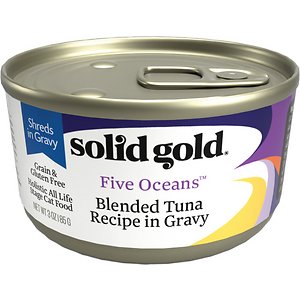
Refine your furry friend’s palate with a bowl of Solid Gold Five Oceans Shreds with Real Tuna Recipe in Gravy Grain-Free Canned Cat Food. This grain-free wet cat food has a hearty shredded texture covered in gravy and contains real tuna and vegetables including pumpkin, spinach and carrots! This gluten-free holistic formula is loaded with vitamins and minerals and provides your cat companion with the complete and balanced nutrition she deserves. It also contains taurine, which helps to support healthy vision and a strong heart and may contribute to normal growth and development for kittens—making this cat pate purr-fectly suitable for all life stages!
Price Score: 48 out of 100 Points
Variety Score: 26 out of 100 Points
Brand Score: 84 out of 100 Points
Ingredients Score: 64 out of 100 Points
Total Score: 61.4 out of 100 Points
Key Benefits
- Made with real tuna and vegetables including pumpkin, spinach and carrots because your furry friend deserves nothing but the best.
- Vitamins, minerals and taurine provide your cat with the complete and balanced nutrition to keep your cat happy and healthy.
- Free from gluten, grains, soy, corn, added sugars, fillers, by-products, artificial coloring, flavoring or preservatives.
- Delectable hearty and shredded texture covered in gravy pairs purr-fectly with your kitty’s favorite kibble.
- Suitable for all life stages from kittens to cats.
Ingredients
Tuna, Water Sufficient For Processing, Tapioca Starch, Sunflower Oil, Carrots, Pumpkin, Spinach, Canola Oil, Tricalcium Phosphate, Calcium Sulfate, Xanthan Gum, Taurine, Magnesium Sulfate, Zinc Oxide, Vitamin E Supplement, Reduced Iron, Niacin Supplement, Thiamine Mononitrate, Sodium Selenite, Vitamin A Supplement, Manganese Sulfate Monohydrate, Vitamin B12 Supplement, Copper Amino Acid Complex, Pyridoxine Hydrochloride, Calcium Pantothenate, Riboflavin Supplement, Biotin Supplement, Vitamin D3 Supplement, Folic Acid, Potassium Iodide, Menadione Sodium Bisulfite Complex (Source Of Vitamin K) Caloric Content 161 kcal/canSee products with the same ingredients:
-
Biotin - Harmless ingredient
(242)
Biotin also called vitamin H, vitamin B7 or vitamin B8 is a water-soluble B vitamin. It is involved in a wide range of metabolic processes, both in humans and in other organisms, primarily related to the utilization of fats, carbohydrates, and amino acids.
-
Calcium Pantothenate - Controversial ingredient
(135)
-
Calcium Sulfate (24)
Calcium sulfate is the inorganic compound with the formula CaSO4 and related hydrates. In the form of γ-anhydrite, it is used as a desiccant. One particular hydrate is better known as plaster of Paris, and another occurs naturally as the mineral gypsum.
-
Canola Oil (18)
Canola oil is a vegetable oil derived from a variety of rapeseed that is low in erucic acid, as opposed to colza oil. There are both edible and industrial forms produced from the seed of any of several cultivars of the plant family Brassicaceae, namely cultivars of Brassica napus L., Brassica rapa subsp.
-
Carrots - Healthy ingredient
(70)
The carrot (Daucus carota subsp. sativus) is a root vegetable, usually orange in colour, though purple, black, red, white, and yellow cultivars exist. They are a domesticated form of the wild carrot, Daucus carota, native to Europe and Southwestern Asia. The plant probably originated in Persia and was originally cultivated for its leaves and seeds.
-
Copper Amino Acid Complex (23)
-
Folic Acid - Harmless ingredient
(235)
Folate, also known as vitamin B9 and folacin, is one of the B vitamins. Manufactured folic acid, which is converted into folate by the body, is used as a dietary supplement and in food fortification as it is more stable during processing and storage.
-
Magnesium Sulfate (31)
Magnesium sulfate is an inorganic salt with the formula MgSO4x where 0≤x≤7. It is often encountered as the heptahydrate sulphate mineral epsomite, commonly called Epsom salt. The overall global annual usage in the mid-1970s of the monohydrate was 2.3 million tons, of which the majority was used in agriculture.
-
Manganese Sulfate Monohydrate (3)
-
Niacin - Harmless ingredient
(238)
Niacin, also known as nicotinic acid, is an organic compound and a form of vitamin B3, an essential human nutrient. It has the formula C 6H 5NO 2 and belongs to the group of the pyridinecarboxylic acid. Niacin is obtained in the diet from a variety of whole and processed foods, with highest contents in fortified packaged foods, tuna, salmon, some vegetable and other animal sources.
-
Potassium Iodide - Harmless ingredient
(85)
Potassium iodide is a chemical compound, medication, and dietary supplement. As a medication it is used to treat hyperthyroidism, in radiation emergencies, and to protect the thyroid gland when certain types of radiopharmaceuticals are used. In the developing world it is also used to treat skin sporotrichosis and phycomycosis.
-
Pumpkin (23)
A pumpkin is a cultivar of winter squash that is round with smooth, slightly ribbed skin, and most often deep yellow to orange in coloration. The thick shell contains the seeds and pulp. The name is most commonly used for cultivars of Cucurbita pepo, but some cultivars of Cucurbita maxima, C.
-
Pyridoxine Hydrochloride - Harmless ingredient
(238)
-
Reduced Iron (1)
-
Riboflavin - Harmless ingredient
(244)
Riboflavin, also known as vitamin B2, is a vitamin found in food and used as a dietary supplement. Food sources include eggs, green vegetables, milk and other dairy product, meat, mushrooms, and almonds. Some countries require its addition to grains. As a supplement it is used to prevent and treat riboflavin deficiency and prevent migraines.
-
Sodium Selenite - Harmful ingredient
(166)
-
Spinach (22)
Spinach is a leafy green flowering plant native to central and western Asia. It is of the order Caryophyllales, family Amaranthaceae, subfamily Chenopodioideae. Its leaves are a common edible vegetable consumed either fresh, or after storage using preservation techniques by canning, freezing, or dehydration.
-
Sunflower Oil (19)
Sunflower oil is the non-volatile oil pressed from the seeds of sunflower. Sunflower oil is commonly used in food as a frying oil, and in cosmetic formulations as an emollient. The world's total production of sunflower oil in 2014 was nearly 16 million tonnes, with Ukraine and Russia as the largest producers.
-
Tapioca Starch (26)
-
Taurine - Healthy ingredient
(151)
Taurine, or 2-aminoethanesulfonic acid, is an organic compound that is widely distributed in animal tissues. It is a major constituent of bile and can be found in the large intestine, and accounts for up to 0.1% of total human body weight.
-
Thiamine Mononitrate - Harmless ingredient
(256)
-
Tricalcium Phosphate - Controversial ingredient
(46)
Tricalcium phosphate is a calcium salt of phosphoric acid with the chemical formula Ca32. It is also known as tribasic calcium phosphate and bone phosphate of lime. It is a white solid of low solubility. Most commercial samples of "tricalcium phosphate" are in fact hydroxyapatite.
-
Tuna (24)
A tuna is a saltwater fish that belongs to the tribe Thunnini, a subgrouping of the Scombridae family. The Thunnini comprise 15 species across five genera, the sizes of which vary greatly, ranging from the bullet tuna (max. length: 50 cm, weight: 1.8 kg ) up to the Atlantic bluefin tuna (max.
-
Vitamin A - Harmless ingredient
(215)
Vitamin A is a group of unsaturated nutritional organic compounds that includes retinol, retinal, retinoic acid, and several provitamin A carotenoids. Vitamin A has multiple functions: it is important for growth and development, for the maintenance of the immune system, and for good vision.
-
Vitamin B12 - Harmless ingredient
(257)
Vitamin B12, also known as cobalamin, is a water-soluble vitamin involved in the metabolism of every cell of the human body: it is a cofactor in DNA synthesis, and in both fatty acid and amino acid metabolism. It is particularly important in the normal functioning of the nervous system via its role in the synthesis of myelin, and in the maturation of developing red blood cells in the bone marrow.
-
Vitamin D3 - Harmless ingredient
(244)
Cholecalciferol, also known as vitamin D3 and colecalciferol, is a type of vitamin D which is made by the skin when exposed to sunlight; it is also found in some foods and can be taken as a dietary supplement. It is used to treat and prevent vitamin D deficiency and associated diseases, including rickets.
-
Vitamin E - Harmless ingredient
(283)
Vitamin E is a group of eight fat soluble compounds that include four tocopherols and four tocotrienols. Vitamin E deficiency, which is rare and usually due to an underlying problem with digesting dietary fat rather than from a diet low in vitamin E, can cause nerve problems.
-
Vitamin K (16)
Vitamin K is a group of structurally similar, fat-soluble vitamins found in foods and in dietary supplements. The human body requires vitamin K for complete synthesis of certain proteins that are needed for blood coagulation or for controlling binding of calcium in bones and other tissues.
-
Water (68)
Water is an inorganic, transparent, tasteless, odorless, and nearly colorless chemical substance, which is the main constituent of Earth's hydrosphere and the fluids of most living organisms. It is vital for all known forms of life, even though it provides no calories or organic nutrients.
-
Xanthan Gum - Low-quality ingredient
(44)
Xanthan gum is a polysaccharide with many industrial uses, including as a common food additive. It is an effective thickening agent and stabilizer to prevent ingredients from separating. It can be produced from simple sugars using a fermentation process, and derives its name from the species of bacteria used, Xanthomonas campestris..
-
Zinc Oxide - Harmful ingredient
(65)
Zinc oxide is an inorganic compound with the formula ZnO. ZnO is a white powder that is insoluble in water, and it is widely used as an additive in numerous materials and products including rubbers, plastics, ceramics, glass, cement, lubricants, paints, ointments, adhesives, sealants, pigments, foods, batteries, ferrites, fire retardants, and first-aid tapes.
Guaranteed Analysis
| Crude Protein | 13.0% min |
|---|---|
| Crude Fat | 2.0% min |
| Crude Fiber | 1.0% max |
| Moisture | 80.0% max |
| Ash | 3.0% max |
Dry Matter Basis
| Crude Protein | 65.0% |
|---|---|
| Crude Fat | 10.0% |
| Crude Fiber | 5.0% |
| Moisture | 400.0% |