Compare Prices To Find The Lowest Price




Description
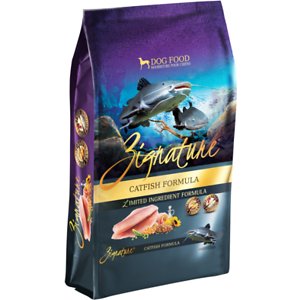
Deliver healthy nutrition in every bite with Zignature Catfish Limited Ingredient Formula Grain-Free Dry Dog Food. Offering a unique and hypoallergenic protein option, it’s great for dogs with allergies or sensitivities—and that’s just the beginning of why catfish is so great for your furry pal. Loaded with protein and amino acids, it comes with a variety of health benefits that will keep him thriving—including special fat that aids in absorbing all the essential nutrients that are packed into this recipe. But he’ll just care about the great flavor, which will keep him coming back to the bowl as he gobbles down bite after bite of good-for-him food.
Price Score: 55 out of 100 Points
Variety Score: 85 out of 100 Points
Brand Score: 92 out of 100 Points
Ingredients Score: 67 out of 100 Points
Total Score: 78.4 out of 100 Points
Key Benefits
- Unique, alternative protein is hypoallergenic, making it great for dogs with allergies or sensitivities.
- Catfish is a rich dietary source of protein, containing a healthy amino acid profile that supports digestion.
- Amino acids also help regulate hormones, build muscles, fix tissue in tendons, ligaments, cartilages, and maintain healthy skin, hair, and nails.
- Includes omega-3 and omega-6 fatty acids that are adept at reducing inflammation, arthritis and other joint problems.
- Low glycemic and free of grain, corn, wheat, soy, dairy, chicken, chicken eggs or chicken by-products.
Ingredients
New: Catfish, Catfish Meal, Peas, Pea Flour, Chickpeas, Sunflower Oil, Flaxseed, Natural Flavors, Salt, Taurine, Vitamins (Vitamin A Acetate, Vitamin D3 Supplement, Vitamin E Supplement, Niacin Supplement, D‐Calcium Pantothenate, Thiamine Mononitrate, Pyridoxine Hydrochloride, Riboflavin Supplement, Folic Acid, Vitamin B12 Supplement), Calcium Carbonate, Choline Chloride, Tricalcium Phosphate, Minerals (Zinc Proteinate, Iron Proteinate, Copper Proteinate, Manganese Proteinate, Sodium Selenite Calcium Iodate), Potassium Chloride, Mixed Tocopherols Preserved, L-Carnitine. Original: Catfish, Catfish Meal, Peas, Pea Flour, Chickpeas, Sunflower Oil (Preserved With Citric Acid), Flaxseed, Natural Flavors, Salt, Vitamins (Vitamin A Acetate, Vitamin D3 Supplement, Vitamin E Supplement, Niacin Supplement, D-Calcium Pantothenate, Thiamine Mononitrate, Pyridoxine Hydrochloride, Riboflavin Supplement, Folic Acid, Vitamin B12 Supplement), Calcium Carbonate, Choline Chloride, Tricalcium Phosphate, Minerals (Zinc Proteinate, Iron Proteinate, Copper Proteinate, Manganese Proteinate, Sodium Selenite Calcium Iodate), Potassium Chloride, Preserved With Mixed Tocopherols. Caloric Content 410 kcal/cupSee products with the same ingredients:
-
Calcium Carbonate - Harmless ingredient
(155)
Calcium carbonate is a chemical compound with the formula CaCO3. It is a common substance found in rocks as the minerals calcite and aragonite and is the main component of pearls and the shells of marine organisms, snails, and eggs.
-
Catfish (2)
Catfish are a diverse group of ray-finned fish. Named for their prominent barbels, which resemble a cat's whiskers, catfish range in size and behavior from the three largest species alive, the Mekong giant catfish from Southeast Asia, the wels catfish of Eurasia, and the piraíba of South America, to detritivores, and even to a tiny parasitic species commonly called the candiru, Vandellia cirrhosa.
-
Catfish Meal (1)
-
Chickpeas - Controversial ingredient
(37)
The chickpea or chick pea is an annual legume of the family Fabaceae, subfamily Faboideae. Its different types are variously known as gram or Bengal gram, garbanzo or garbanzo bean, Egyptian pea, chana, and chole. Chickpea seeds are high in protein.
-
Choline Chloride - Harmless ingredient
(236)
Choline chloride is an organic compound with the formula 3NCH2CH2OH]Cl. It is bifunctional, containing both quaternary ammonium salt and an alcohol. The cation is choline, which occurs naturally. It is a white, water-soluble salt used mainly in animal feed..
-
Copper Proteinate - Controversial ingredient
(89)
-
D-Calcium Pantothenate - Controversial ingredient
(110)
-
Flaxseed - Healthy ingredient
(47)
Flax, also known as common flax or linseed, is a member of the genus Linum in the family Linaceae. It is a food and fiber crop cultivated in cooler regions of the world. Textiles made from flax are known in the Western countries as linen, and traditionally used for bed sheets, underclothes, and table linen.
-
Folic Acid - Harmless ingredient
(235)
Folate, also known as vitamin B9 and folacin, is one of the B vitamins. Manufactured folic acid, which is converted into folate by the body, is used as a dietary supplement and in food fortification as it is more stable during processing and storage.
-
Iron Proteinate - Controversial ingredient
(68)
-
L-Carnitine (27)
Carnitine is a quaternary ammonium compound involved in metabolism in most mammals, plants, and some bacteria. Carnitine exists as one of two stereoisomers. Both are biologically active but only l-carnitine naturally occurs in animals and d-carnitine is toxic as it inhibits the activity of the l-form.
-
Manganese Proteinate - Controversial ingredient
(78)
-
Natural Flavors - Controversial ingredient
(38)
Flavor, flavour, or taste is the perceptual impression of food or other substances, and is determined primarily by the chemical senses of the gustatory and olfactory system. The "trigeminal senses", which detect chemical irritants in the mouth and throat, as well as temperature and texture, are also important to the overall gestalt of flavor perception.
-
Niacin - Harmless ingredient
(238)
Niacin, also known as nicotinic acid, is an organic compound and a form of vitamin B3, an essential human nutrient. It has the formula C 6H 5NO 2 and belongs to the group of the pyridinecarboxylic acid. Niacin is obtained in the diet from a variety of whole and processed foods, with highest contents in fortified packaged foods, tuna, salmon, some vegetable and other animal sources.
-
Pea Flour (12)
-
Peas - Healthy ingredient
(68)
The pea is most commonly the small spherical seed or the seed-pod of the pod fruit Pisum sativum. Each pod contains several peas, which can be green or yellow. Botanically, pea pods are fruit, since they contain seeds and develop from the ovary of a flower.
-
Potassium Chloride - Low-quality ingredient
(208)
Potassium chloride is a metal halide salt composed of potassium and chlorine. It is odorless and has a white or colorless vitreous crystal appearance. The solid dissolves readily in water, and its solutions have a salt-like taste. KCl is used as a fertilizer, in medicine, in scientific applications, and in food processing, where it may be known as E number additive E508.
-
Pyridoxine Hydrochloride - Harmless ingredient
(238)
-
Riboflavin - Harmless ingredient
(244)
Riboflavin, also known as vitamin B2, is a vitamin found in food and used as a dietary supplement. Food sources include eggs, green vegetables, milk and other dairy product, meat, mushrooms, and almonds. Some countries require its addition to grains. As a supplement it is used to prevent and treat riboflavin deficiency and prevent migraines.
-
Salt - Harmless ingredient
(231)
Salt is a mineral consisting primarily of sodium chloride, a chemical compound belonging to the larger class of salts; salt in its natural form as a crystalline mineral is known as rock salt or halite. Salt is present in vast quantities in seawater, where it is the main mineral constituent.
-
Sodium Selenite Calcium Iodate (1)
-
Sunflower Oil (19)
Sunflower oil is the non-volatile oil pressed from the seeds of sunflower. Sunflower oil is commonly used in food as a frying oil, and in cosmetic formulations as an emollient. The world's total production of sunflower oil in 2014 was nearly 16 million tonnes, with Ukraine and Russia as the largest producers.
-
Taurine - Healthy ingredient
(151)
Taurine, or 2-aminoethanesulfonic acid, is an organic compound that is widely distributed in animal tissues. It is a major constituent of bile and can be found in the large intestine, and accounts for up to 0.1% of total human body weight.
-
Thiamine Mononitrate - Harmless ingredient
(256)
-
Tricalcium Phosphate - Controversial ingredient
(46)
Tricalcium phosphate is a calcium salt of phosphoric acid with the chemical formula Ca32. It is also known as tribasic calcium phosphate and bone phosphate of lime. It is a white solid of low solubility. Most commercial samples of "tricalcium phosphate" are in fact hydroxyapatite.
-
Vitamin A Acetate (33)
-
Vitamin B12 - Harmless ingredient
(257)
Vitamin B12, also known as cobalamin, is a water-soluble vitamin involved in the metabolism of every cell of the human body: it is a cofactor in DNA synthesis, and in both fatty acid and amino acid metabolism. It is particularly important in the normal functioning of the nervous system via its role in the synthesis of myelin, and in the maturation of developing red blood cells in the bone marrow.
-
Vitamin D3 - Harmless ingredient
(244)
Cholecalciferol, also known as vitamin D3 and colecalciferol, is a type of vitamin D which is made by the skin when exposed to sunlight; it is also found in some foods and can be taken as a dietary supplement. It is used to treat and prevent vitamin D deficiency and associated diseases, including rickets.
-
Vitamin E - Harmless ingredient
(283)
Vitamin E is a group of eight fat soluble compounds that include four tocopherols and four tocotrienols. Vitamin E deficiency, which is rare and usually due to an underlying problem with digesting dietary fat rather than from a diet low in vitamin E, can cause nerve problems.
-
Zinc Proteinate - Controversial ingredient
(79)
Guaranteed Analysis
| Crude Protein | 32.0% min |
|---|---|
| Crude Fat | 14.0% min |
| Crude Fiber | 3.0% max |
| Moisture | 10.0% max |
| Calcium | 1.6% min |
| Phosphorous | 1.4% min |
| Omega-6 Fatty Acids | 2.7% min |
| Omega-3 Fatty Acids | 0.7% min |
| Taurine | 0.2% min |
| L-Carnitine | 40 mg/kg min |
Dry Matter Basis
| Crude Protein | 35.6% |
|---|---|
| Crude Fat | 15.6% |
| Crude Fiber | 3.3% |
| Moisture | 11.1% |